Optical System Design

Taking the math and the mystery out of optical design, this comprehensive book uses a graphics-oriented approach, making optical design techniques easy to understand through hundreds of detailed diagrams.
 TABLE OF CONTENTS
 At the outset of this chapter, we indicated that the higher refractive indices of many of the infrared transmitting materials results in shallower and less steeply curved surfaces which, in turn, results in reduced aberrations. In order to illustrate this, consider Fig. 12.16, where we show six f/2 single-element lenses 25.4 mm in diameter, each bent for minimum spherical aberration. The refractive index of the lenses ranges from 1.5 to 4.0, where an index of 1.5 would be close to ordinary BK7 glass and 4.0 close to germanium. Note how the shape of the lenses is progressively changing. At index 1.5, the front is steeply convex and the rear is very slightly convex. At an index of approximately 1.62, the rear surface becomes flat. As the index keeps increasing, the lens becomes more concentric looking. While this is indeed very interesting, unfortunately it does not tell us anything about the aberrations.
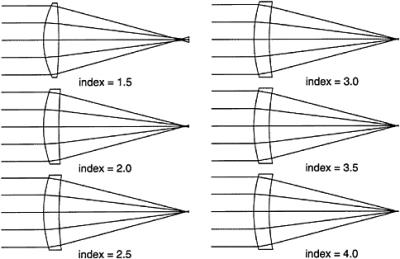
Figure 12.17 shows a plot of the rms wavefront error in waves at the wavelength of 0.5 m versus refractive index for lenses bent for minimum spherical aberration. At index 1.5, we have over 10 waves rms which equates to approximately 50 waves peak to valley! This is an enormous amount of spherical aberration. Note how the aberration rapidly decreases with increasing refractive index. At an index of 2.0, which is about as high as we can...