Optical System Design
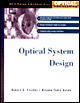
Taking the math and the mystery out of optical design, this comprehensive book uses a graphics-oriented approach, making optical design techniques easy to understand through hundreds of detailed diagrams.
 TABLE OF CONTENTS
 This section is presented in the spirit that we all learn from our mistakes and/or the mistakes of others. The truth is that none of us is perfect, and from time to time even the best of us make mistakes. If we can share, in the right spirit, these mistakes, we will all learn, and our industry will improve. We are careful not to use names or affiliations in any of the following material.
A lens that is fully symmetrical on both sides of a central aperture stop will be free of all orders of distortion, coma, and lateral color. This is because precisely equal and opposite amounts of these aberrations are introduced on each side of the central aperture stop, therefore, producing a net zero aberration at the image. Some years ago, a lens was required which imaged from a convex curved CRT onto a flat groundglass image surface. The lens needed to have less than 0.25% of distortion. The lens was designed to be completely symmetrical about its central aperture stop. Only after the lens was assembled and tested did it become apparent that there was a residual distortion of several percent. This was never checked during the design effort because it was assumed that a fully symmetrical lens had zero distortion. The flaw in this assumption of symmetry was that the curved object surface immediately made the lens nonsymmetrical. This caused the distance from the edge of the field to...