Optical System Design
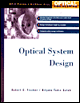
Taking the math and the mystery out of optical design, this comprehensive book uses a graphics-oriented approach, making optical design techniques easy to understand through hundreds of detailed diagrams.
 TABLE OF CONTENTS
 Illumination optics is required in many varied system applications, including, for example, microscopes, projection systems, machine vision systems, industrial lighting. In optical systems where a light source is illuminating an object that has to be projected onto a screen as in a desktop projector, the design often requires a high brightness and uniformity across the image. High brightness implies a high collection efficiency of the light emitted from the source. Furthermore, these systems often require small packaging of the optical system.
Light sources have a wide range of types, shapes, and sizes, and the choice of the design of the illumination optics is very dependent on the source. Sources can be tungsten halogen lamps of different shapes, metal halide lamps, light-emitting diodes (LEDs), xenon lamps, frosted bulbs, different forms of arc lamps, or fusion (sulfur) lamps. Some sources have sufficient brightness and uniformity across their emitting area, and these can be imaged directly onto the object that has to be illuminated, but in most cases the sources need some kind of homogenization in the illumination optics to achieve the required brightness uniformity, while simultaneously minimizing throughput losses. The most common physical parameters that are used in photometry to characterize the source and the illumination system are flux, intensity, illuminance, and brightness. Photometry deals with visual systems, and it is implicit that all relationships are weighted by the spectral sensitivity of the human eye. Clearly, if an object being viewed visually appears to be of a certain brightness,...