Optical System Design
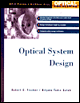
Taking the math and the mystery out of optical design, this comprehensive book uses a graphics-oriented approach, making optical design techniques easy to understand through hundreds of detailed diagrams.
 TABLE OF CONTENTS
 The quantitative characterization of optical performance, or image quality, is extremely important. Generally, the optical design engineer plays a key role in system testing, and for this reason we feel it is important to include the basics of optical testing in this book. Testing can range from the somewhat simplistic bar target to the more sophisticated means for characterizing the modulation transfer function (MTF).
The simplest form of resolution target is perhaps the white picket fence shown in Fig. 15.1. The image of the fence consists of alternating bright and dark bars as formed by the white pickets and the dark background between the pickets. If we image this fence with a camera lens, the image will be demagnified by approximately the ratio of the camera focal length to the distance to the fence. Let s assume the fence pickets are 75-mm wide and that we are imaging the fence with a 50-mm focal length lens from a distance of 20 m. The magnification is therefore 50/20,000 = 0.0025 . The fence is 150 mm/picket pair, or equivalently 150 mm/line pair. This equates to 0.006667 line pairs/mm. At the image formed by our lens, this becomes 0.375 mm/line pair, or 2.667 line pair/mm. Most camera lenses will resolve this spatial frequency just fine, as it is a rather low spatial frequency. Let s now move our lens to a distance of 200 m. Here the magnification is 0.00025 and the spatial frequency becomes 26.67...