Optical System Design
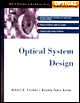
Taking the math and the mystery out of optical design, this comprehensive book uses a graphics-oriented approach, making optical design techniques easy to understand through hundreds of detailed diagrams.
 TABLE OF CONTENTS
 Traditional refractive optics uses multiple glass or plastic elements consisting of spherical and/or aspheric surfaces in order to form an image. For a single material, the fact that the refractive index is higher in the blue than in the red causes the blue light to refract more severely, thereby focusing closer to the lens than the red light. This is known as primary axial color as we learned in Chap. 5 in the section Axial Color. In Chap. 6 we learned how to combine a lower dispersive, positively powered element with a more highly dispersive, negatively powered element so as to bring the red and blue to a common focus position. The result of this process is the familiar achromatic doublet, and the further use of glasses with different dispersion characteristics is responsible for the majority of color-corrected lens systems as used in nearly all image-forming systems.
Diffractive optics allows us to take advantage of diffraction in addition to (or along with) refraction in the design of our optical systems. As you will learn, this can be an extremely powerful tool to the designer, and systems that are simpler and perform significantly better can result. However, diffractive optics is not without problems and issues, including diffraction efficiency and scattering, which can be serious in some applications.
Diffractive optics has as its foundation the classical diffraction grating. In simple terms, a transmissive diffraction grating is a series...