Practical Microstrip Design and Applications

T-junctions are frequently found in microwave circuits in stub filters, power dividers of antenna feeding networks, in stub matching networks, or branch-line couplers. In contrast to an ideal transmission line junction with no parasitic junction effects, the distributed microstrip T-junction includes parasitic capacitive, inductive, and radiation effects. Current flux lines on the strip and the ground plate and the electric and magnetic fields are disturbed in the vicinity of the junction.
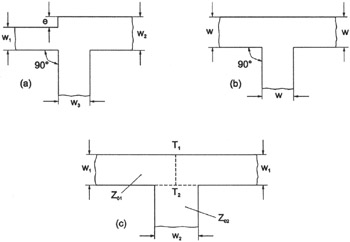
Figure 6.52(a) shows a microstrip T-junction with different line widths in the main line. The symmetric structure shown in Figure 6.52(b) has the same characteristic impedance for the main through line and shunt branch arm. Figure 6.52(c) shows a T-junction with uniform main line and branch line with different characteristic impedance.
Figure 6.52 shows different constructions of T-junctions often used in microstrip circuits. Figure 6.53 shows the quasi-static equivalent circuit of the T-junction with width w 1 for the main line and w 2 for the shunt branch. Formulas for the capacitance and for the inductances have been given by Garg and Bahl [40]. The junction capacitance theoretically calculated by Silvester and Benedek [41] is shown in Figure 6.54.