Practical Microstrip Design and Applications

Quasi-lumped capacitive and inductive components are commonly used up to approximately about 20 GHz in hybrid, and approximately 30 GHz in monolithic technology [61]. This is traced back to the growing influence of parasitics with frequency. The structures behave approximately as lumped elements as long as the maximum dimensions are small compared with the wavelength. As a rule of thumb, the dimensions should not exceed ?/10.
Quasi-lumped elements are often used in microstrip filters and bias networks. Unlike distributed components, quasi-lumped capacitive and inductive elements are less frequency-dependent, so that they are used for the design of broadband microstrip circuits. In the following section, we will see how to realize inductances and capacitances by short microstrip line lengths.
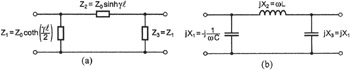
Figure 6.77(a) shows the equivalent ?-network of a transmission line of length l. ? is the propagation coefficient of the line. Assuming lossless transmission lines, the equivalent circuit becomes the pure reactive circuit shown in Figure 6.77(b). The reactances read
| (6.116) | |
| (6.117) | |
where
From (6.117), the inductance L for the line length l reads
| (6.118) | |
Or for a given L value, the necessary length l is
| (6.119) | |
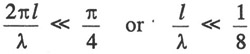
When the line length is very short,
| (6.120) | |
then (6.118) and (6.119) read
| (6.121) | |
| (6.122) | |
The shunt elements of the equivalent circuit in Figure 6.77(b) represent the capacitance per unit length multiplied by the line...