Practical Microstrip Design and Applications

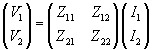
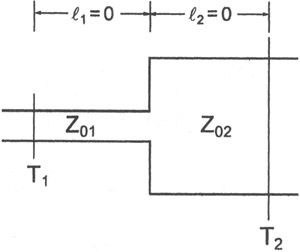
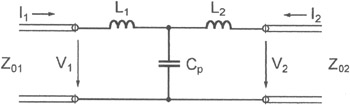
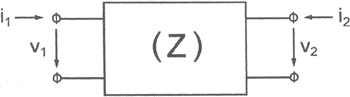
Figure I.1 shows the top view of the microstrip discontinuity under study and Figure I.2 shows the equivalent circuit of a microstrip step discontinuity with an input line of characteristic impedance Z 01 and output line of characteristic impedance Z 02. I 1 and V 1 are the current and voltage at port 1, and I 2 and V 2 are the current and voltage at port 2. The impedance matrix reads
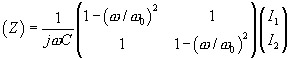
| (I.1) | |
Referring to the equivalent T-network (Section G.1), the impedance matrix is obtained as (G.16)
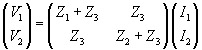
With the given reactive elements, the Z matrix reads
| (I.2) | |
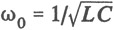
where
. Using normalized currents and voltages (Section G.2), and taking into account the different characteristic impedances at ports 1 and 2,
| (I.3) | |
equation (I.1) reads
| (I.4) | |
| (I.5) | |
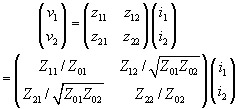
or in matrix form,
| (I.6) | |
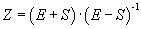
Figure I.3 shows the simple representation of the two-port of the step discontinuity. The impedance matrix can be calculated from the (measured) S matrix [1],
| (I.7) | |
with the unit vector E.
Because the characteristic impedances of the ports are different, it is useful to normalize the matrix elements to a single reference impedance. In this case, the ideal transformer must be included to adequately describe the step discontinuity. In the following section, we will normalize all impedance parameters with respect to the input impedance Z 01