Practical Microstrip Design and Applications

The analysis of waveguiding structures requires the solution of the complete set of Maxwell equations, which relate the field vectors
,
,
,
, and
and the scalar free electric space charge density ? to each other.
is called the magnetic flux density, magnetic field strength, or the magnetic induction, whereas
is called the magnetic field. Often the distinction is ignored, and both symbols are frequently referred to as the magnetic field [1].
is the electric field,
is the electric displacement field, and
is the current density. In general, these quantities are space- and time-dependent. The Maxwell equations [2, 3], originally derived from experience, can be written both in integral and differential form. Not all the knowledge gained from experience is reflected by the Maxwell equations; for example, the quantization of charge, or the fact that the energy content of any system has to be finite. In particular cases, additional conditions must be defined. However, classical waveguiding problems can be solved with the standard Maxwell equations. The Maxwell equations in integral form read:
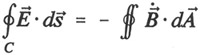
| (D.1) | |
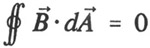
| (D.2) | |
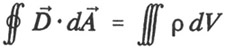
| (D.3) | |
| (D.4) | |
Note that the dot on a vector or scalar denotes a time derivative. When the integration boundaries are invariant with time (i.e., when the integration area does not change in a stationary material), the integration and the time differentiation can be interchanged,
| (D.5) | |
Maxwell equations (D.1) and (D.2) relate an integral over an arbitrary surface A to a contour integral along the...