Practical Microstrip Design and Applications
A circuit is an interconnection of n-port components that interact only at the ports. Each n-port is described by n 2 complex parameters. The circuit behavior can be predicted solely from knowledge of these parameters. Circuit analysis can be based on the voltage-current description, or make use of the S matrix concept.
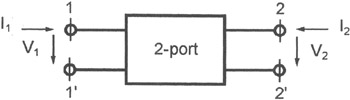
The electrical properties of an n-port can be described by various circuit parameters interrelating voltage V and current I at the ports of an n-port, such as H, Y, and Z. For a two-port (Figure G.1), the following relations are valid:
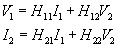
The H parameters, also termed hybrid coefficients, relate the input voltage and output current, respectively, to the input current and output voltage:
| (G.1) | |
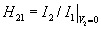
The H matrix is often used for the characterization of transistor devices [1]. In particular
| (G.2) | |
denotes the current gain. H 21 is measured with short-circuited termination at port 2.
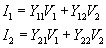
The Y parameter relates the port currents to the port voltages,
| (G.3) | |
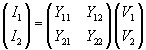
In matrix form, (G.3) reads
| (G.4) | |
or
| (G.5) | |
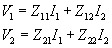
The Z parameter relates the port voltages to the port currents,
| (G.6) | |
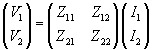
In matrix form, (G.6) reads,
| (G.7) | |
or
| (G.8) | |
The Z and Y matrices are the inverses of each other:
| (G.9) | |
Note that both the Z and Y matrices relate...