Practical Microstrip Design and Applications
In this chapter, some frequently used microstrip circuits are discussed concerning the design of microstrip filters, matching networks for power amplifiers, and directional couplers.
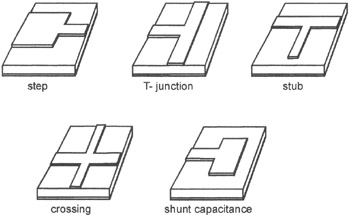
Filter circuits are of great importance in communication systems. They are used, for example, for frequency band selection, channel separation, noise suppression, and matching. Microstrip filters generally include a number of discontinuities and junctions with parasitic capacitive and inductive effects, both of which are frequency-dependent. Figure 8.1 shows frequently used basic filter elements, such as T-junctions, stubs, steps, crossings, and shunt capacitances, which have been analyzed successfully by the mode matching procedure using the microstrip waveguide model (Chapter 5) [1 5].
The intention of this chapter is to consider microstrip discontinuities and junctions in a broader context of microstrip circuit design. Filter components are suitable representatives to study different kinds of parasitic effects, such as electrical stray fields at the transitions that entail shift of reference planes, perturbation of current flow leading to parasitic inductive effects, and at higher frequencies, higher-order mode excitation and radiation. As was already mentioned, the main scope of the book is the fundamental understanding of the physical effects commonly occurring in microstrip circuits. This knowledge will help the designer to analyze the performance of the circuit, and, what is most important, to improve it systematically with the help of commercially available software packages. But the designer should also be always fully aware of the limitation of any model due to frequency,...