Practical Microstrip Design and Applications

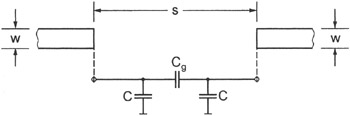
The series gap interrupts the conductive strip of the microstrip line. The dc power cannot be transmitted. RF power transfer is accomplished by electrical field coupling. In Section 4.3.2, the gap was used to excite microstrip resonators. Figure 6.108 shows the top view of the frequently used symmetric gap structure with identical line width on both sides, and its equivalent circuit having purely capacitive equivalent circuit parameters. This is not given for the general case of an asymmetric gap of different line widths. Since it looks like a capacitively coupled abrupt impedance step, inductive equivalent circuit parameters have to be included [78].
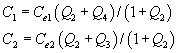
The gap can be described as two coupled open-ended microstrip lines. Thus, the capacitance C refers to the open-end capacitance, and the series gap capacitance C g describes the electrical coupling. Up to approximately 20 GHz, the frequency dependence of the equivalent capacitances is negligible [38, 78]. Figure 6.109 shows the equivalent capacitances of a symmetric gap on alumina substrate ( ? r = 9.6) after Hoffmann [45] using a numerical static method [79, 80]. More accurate formulas for the capacitances have been published by Kirschning et al. [7, 45, 81]:
| (6.226) | |
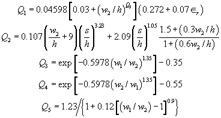
where
C e 1 and C e 2 denote the respective capacitance of the open-end microstrip lines. Equation (6.226) was found by curvefitting to numerical data of full-wave analysis at a frequency of 4 GHz. The maximum error of...