Practical Microstrip Design and Applications
Appendix H: Orthogonal Series Expansion Method

Overview

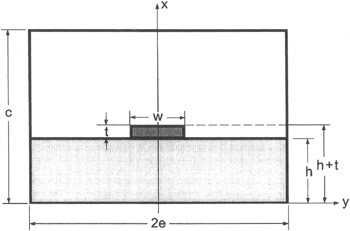
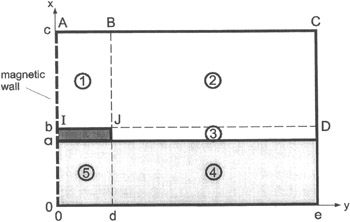
The method of orthogonal series expansion is applied to calculate the field distribution of the quasi-TEM mode in a shielded microstrip line [1], as shown in Figure H.1. It is assumed that the electromagnetic field within the shielded field region (Figure H.1) can be described by a series presentation of fields in subregions fulfilling the continuity condition at the interfaces. The quasi-TEM mode is an even mode. Even modes have the property that the electrical field distribution is symmetrical with respect to the x-z plane at y = 0. Thus, the mathematical problem can be simplified by treating only one-half of the microstrip structure, as shown in Figure H.2. The symmetry plane at y = 0 represents a magnetic wall or an ideal electrical open.


Figure H.1: Cross-section of the shielded microstrip transmission line.

Figure H.2: Subdivision of the field region in the transversal plane.

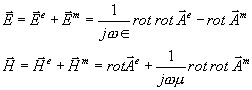
The modes in microstrip lines are hybrid modes with both longitudinal electric and magnetic field components. These fields can be described by the superposition of E ( TM) modes (with longitudinal electric field component) and H ( TE) modes (with longitudinal magnetic field component). As pointed out in Section D.2.2, the electric and magnetic fields read (D.143) and (D.144)


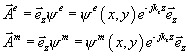
with


The equations are valid for the field components and in the subregions 1 to 5. is the unit vector in the z-direction and k z is the propagation coefficient in the z

UNLIMITED FREE
ACCESS
TO THE WORLD'S BEST IDEAS

SUBMIT
Already a GlobalSpec user? Log in.

This is embarrasing...

An error occurred while processing the form. Please try again in a few minutes.

Customize Your GlobalSpec Experience

Category: RF Waveguide Tees
Finish!
Privacy Policy

This is embarrasing...

An error occurred while processing the form. Please try again in a few minutes.