Secrets of RF Circuit Design, Third Edition
This chapter covers inductance ( L) and capacitance ( C), how they are affected by ac signals, and how they are combined into LC-tuned circuits. The tuned circuit allows the radio-frequency (RF) circuit to be selective about the frequency being passed. Alternatively, in the case of oscillators, LC components set the operating frequency of the circuit.
Tuned resonant circuits, also called tank circuits or LC circuits, are used in the radio front end to select from the myriad of stations available at the antenna. The tuned resonant circuit is made up of two principal components: inductors and capacitors, also known in old radio books as condensers. This section examines inductors and capacitors separately, and then in combination, to determine how they function to tune a radio s RF, intermediate-frequency (IF), and local oscillator (LO) circuits. First, a brief digression is needed to discuss vectors because they are used in describing the behavior of these components and circuits.
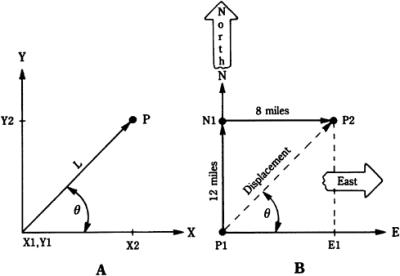
A vector (Fig. 2-1A) is a graphical device that is used to define the magnitude and direction (both are needed) of a quantity or physical phenomenon. The length of the arrow defines the magnitude of the quantity, and the direction in which it points defines the direction of action of the quantity being represented.