Secrets of RF Circuit Design, Third Edition
Radio receivers are a key element in radio communications and broadcasting systems. This chapter presents some of the more important receiver specification parameters. It will help you understand receiver spec sheets and lab test results.
A radio receiver must perform two basic functions:
It must respond to, detect, and demodulate desired signals
It must not respond to, detect, or be adversely affected by undesired signals.
Both functions are necessary, and weakness in either makes a receiver a poor bargain. The receiver s performance specifications tell us how well the manufacturer claims that their product does these two functions.
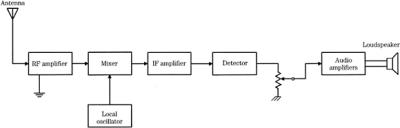
Figure 9-1 shows the block diagram of a simple communications receiver. We will use this hypothetical receiver as the basic generic framework for evaluating receiver performance. The design in Fig. 9-1 is called a superheterodyne receiver and is representative of a large class of radio receivers; it covers the vast majority of receivers on the market. Other designs, such as the tuned radio frequency (TRF) and direct-conversion receivers (DCR), are simply not in widespread commercial use today.
The main attribute of the superheterodyne receiver is that it converts the radio signal s RF frequency to a standard frequency for further processing. Although today the new frequency, called the intermediate frequency (IF), might be either higher or lower than the RF frequencies, early superheterodyne receivers were always down-converted to a lower IF frequency (IF...