Secrets of RF Circuit Design, Third Edition
Chapter 11: RF directional couplers

Overview

Directional couplers are devices that will pass signal across one path while passing a much smaller signal along another path. One of the most common uses of the directional coupler is to sample a RF power signal either for controlling transmitter output power level or for measurement. An example of the latter use is to connect a digital frequency counter to the low-level port and the transmitter and antenna to the straight-through (high-power) ports.

The circuit symbol for a directional coupler is shown in Fig. 11-1. Note that there are three outputs and one input. The IN OUT path is low-loss and is the principal path between the signal source and the load. The coupled output is a sample of the forward path while the isolated showed very low signal. If the IN and OUT are reversed then the roles of the coupled and isolated ports also reversed.


Figure 11-1: Directional coupler circuit symbol

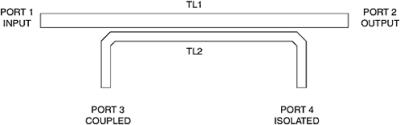
An implementation of this circuit using transmission line segments is shown in Fig. 11-2. Each transmission line segment (TL 1 and TL 2) has a characteristic impedance, Z o, and is a quarter-wavelength long. The path from port 1 to port 2 is the low-loss signal direction. If power flows in this direction, then port 3 is the coupled port and port 4 is isolated. If the power flow direction reverses (port 2 to port 1) then the respective roles of port 3 and port 4 are reversed.


Figure...

UNLIMITED FREE
ACCESS
TO THE WORLD'S BEST IDEAS

SUBMIT
Already a GlobalSpec user? Log in.

This is embarrasing...

An error occurred while processing the form. Please try again in a few minutes.

Customize Your GlobalSpec Experience

Category: RF Couplers
Finish!
Privacy Policy

This is embarrasing...

An error occurred while processing the form. Please try again in a few minutes.