Secrets of RF Circuit Design, Third Edition
Chapter 8: Building IF amplifiers

Overview

Most of the gain and selectivity of a superheterodyne radio receiver are in the intermediate frequency (IF) amplifier. The IF amplifier is, therefore, a high-gain, narrow-bandwidth amplifier. Typically, IF power gains run in the 60- to 120-dB range, depending on the receiver design. It usually has far narrower bandwidth than the RF amplifier. For example, 2.8 KHz for an SSB receiver and 500 Hz for a CW receiver.

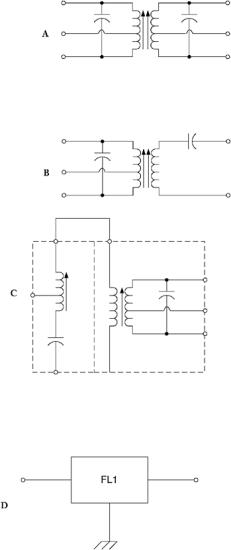
The purpose of the IF amplifier is to provide gain and selectivity to the receiver. The selectivity portion of the equation is provided by any of several different types of filter circuit. Figure 8-1 shows several different filters used in IF amplifiers. The classical circuit is shown in Fig. 8-1A. This transformer is shown with taps, but it may also exist without the taps. The taps provide a low-impedance connection while retaining the overall advantages of high-impedance tuned circuits. Note that the capacitors are usually inside the transformer shielded can. A slightly different version is shown in Fig. 8-1B. This transformer differs from the one previous in that the secondary winding is capacitor coupled to its load and that capacitor may or may not be resonating. Still a third version is had by making the secondary winding an untuned low-impedance loop.


Figure 8-1: Various IF filters.

A somewhat different approach is shown in Fig. 8-1C. This transformer is a series-resonant tapped circuit on the input end and parallel-tuned and tapped on the output end. It requires two shield cans to...

UNLIMITED FREE
ACCESS
TO THE WORLD'S BEST IDEAS

SUBMIT
Already a GlobalSpec user? Log in.

This is embarrasing...

An error occurred while processing the form. Please try again in a few minutes.

Customize Your GlobalSpec Experience

Category: Single Phase Transformers
Finish!
Privacy Policy

This is embarrasing...

An error occurred while processing the form. Please try again in a few minutes.