Secrets of RF Circuit Design, Third Edition

The mathematics of transmission lines, and certain other devices, becomes cumbersome at times, especially when dealing with complex impedances and nonstandard situations. In 1939, Philip H. Smith published a graphical device for solving these problems, followed in 1945 by an improved version of the chart. That graphic aid, somewhat modified over time, is still in constant use in microwave electronics and other fields where complex impedances and transmission line problems are found. The Smith chart is indeed a powerful tool for the RF designer.
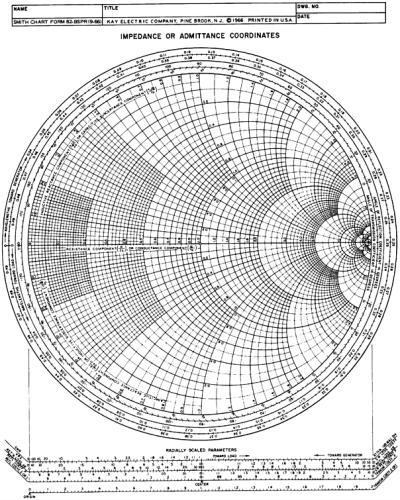
The modern Smith chart is shown in Fig. 26-1 and consists of a series of overlapping orthogonal circles (i.e., circles that intersect each other at right angles). This chapter will dissect the Smith chart so that the origin and use of these circles is apparent. The set of orthogonal circles makes up the basic structure of the Smith chart.
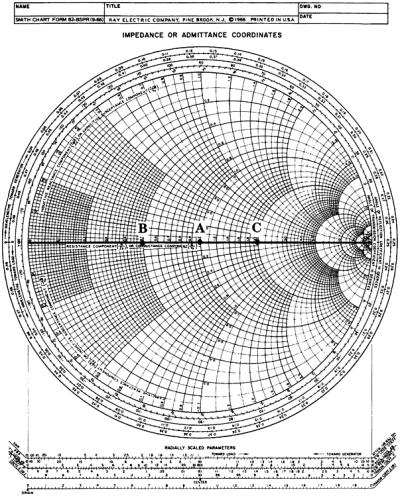
A baseline is highlighted in Fig. 26-2 and it bisects the Smith chart outer circle. This line is called the pure resistance line, and it forms the reference for measurements made on the chart. Recall that a complex impedance contains both resistance and reactance and is expressed in the mathematical form:
| (26-1) | |
where<i class="emphasis"> Z</i> = the complex impedance<i class="emphasis"> R</i> = the resistive component of the impedance<i class="emphasis"> X</i> = the...