Secrets of RF Circuit Design, Third Edition
This chapter explores a device that has applications in general RF electronics as well as in antenna work: the RF noise bridge. It is one of the most useful, low-cost, and over-looked test instruments in the servicer s armamentarium.
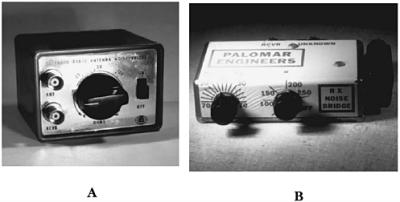
Several companies have produced low-cost noise bridges: Omega-T, Palomar Engineers, and the now out-of-the-kit-business Heath Company. The Omega-T device (Fig. 17-1A) is a small cube with minimal dials and a pair of BNC coax connectors (marked antenna and receiver). The dial is calibrated in ohms and measures only the resistive component of impedance. The Palomar Engineers device (Fig. 17-1B) is a little less eye-appealing but does everything the Omega-T does, plus it allows you to make a rough measurement of the reactive component of impedance.
The Heath Company had their Model HD-1422 in the line-up. Over the years, I have found the noise bridge terribly useful for a variety of test and measurement applications especially in the HF and low-VHF regions, and those applications are not limited to the testing of antennas (which is the main job of the noise bridge). In fact, the two-way technician (including CB) will measure antennas with the device, but consumer technicians will find other applications.
Figure 17-2 shows the block diagram of this instrument. The bridge consists of four arms. The inductive arms ( L 1b and L 1c) form a trifilar-wound transformer over a ferrite core with L 1a