Secrets of RF Circuit Design, Third Edition

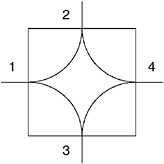
The hybrid coupler (Fig. 12-1) is an AF or RF device that will either (a) split a signal source into two directions or (b) combine two signal sources into a common path. The circuit symbol shown in Fig. 12-1 is essentially a signal path schematic. Consider the situation where an RF signal is applied to port 1. This signal is divided equally, flowing to both ports 2 and 3.
Because the power is divided equally the hybrid is called a 3-dB divider, i.e., the power level at each adjacent port is one-half ( ?3 dB) of the power applied to the input port.
If the ports are properly terminated in the system impedance then all power is absorbed in the loads connected to the ports adjacent to the injection port. None travels to the opposite port. The termination of the opposite port is required, but it does not dissipate power because the power level is zero.
The one general rule to remember about hybrids is that opposite ports cancel. That is, power applied to one port in a properly terminated hybrid will not appear at the opposite port. In the case cited above, the power was applied to port 1 so no power appeared at port 4.
One of the incredibly useful features of the hybrid is that it accomplishes this task while allowing all devices connected to it to see the system impedance, R o. For example, if the...