Secrets of RF Circuit Design, Third Edition

Chapter 3: Variable capacitors in RF circuits

Overview

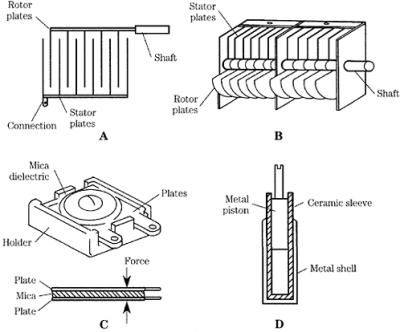
Like all capacitors, variable capacitors are made by placing two sets of metal plates parallel to each other (Fig. 3-1A) separated by a dielectric of air, mica, ceramic, or a vacuum. The difference between variable and fixed capacitors is that, in variable capacitors, the plates are constructed in such a way that the capacitance can be changed. There are two principal ways to vary the capacitance: either the spacing between the plates is varied or the cross-sectional area of the plates that face each other is varied. Figure 3-1B shows the construction of a typical variable capacitor used for the main tuning control in radio receivers. The capacitor consists of two sets of parallel plates. The stator plates are fixed in their position and are attached to the frame of the capacitor. The rotor plates are attached to the shaft that is used to adjust the capacitance.


Figure 3-1: Air dielectric variable capacitors consists of interleaved stator and rotor plates. (A) Schematic view; (B) construction; (C) mica compression variable capacitor; (D) piston variable capacitor.

Another form of variable capacitor used in radio receivers is the compression capacitor shown in Fig. 3-1C. It consists of metal plates separated by sheets of mica dielectric. In order to increase the capacitance, the manufacturer may increase the area of the plates and mica or the number of layers (alternating mica/metal) in the assembly. The entire capacitor will be mounted on a ceramic or other form of holder. If mounting screws or holes...

UNLIMITED FREE
ACCESS
TO THE WORLD'S BEST IDEAS

SUBMIT
Already a GlobalSpec user? Log in.

This is embarrasing...

An error occurred while processing the form. Please try again in a few minutes.

Customize Your GlobalSpec Experience

Category: Capacitors
Finish!
Privacy Policy

This is embarrasing...

An error occurred while processing the form. Please try again in a few minutes.