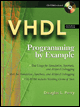
VHDL: Programming By Example, Fourth Edition
No matter what your current level of expertise, nothing will have you writing and verifying concise, efficient VHDL descriptions of hardware designs as fast or as painlessly as this classic tutorial.
 TABLE OF CONTENTS
 The VHSIC Hardware Description Language is an industry standard language used to describe hardware from the abstract to the concrete level. VHDL resulted from work done in the 70s and early 80s by the U.S. Department of Defense. Its roots are in the ADA language, as will be seen by the overall structure of VHDL as well as other VHDL statements.
VHDL usage has risen rapidly since its inception and is used by literally tens of thousands of engineers around the globe to create sophisticated electronic products. This chapter will start the process of easing the reader into the complexities of VHDL. VHDL is a powerful language with numerous language constructs that are capable of describing very complex behavior. Learning all the features of VHDL is not a simple task. Complex features will be introduced in a simple form and then more complex usage will be described.
In 1986, VHDL was proposed as an IEEE standard. It went through a number of revisions and changes until it was adopted as the IEEE 1076 standard in December 1987. The IEEE 1076-1987 standard VHDL is the VHDL used in this book. (Appendix D contains a brief description of VHDL 1076-1993.) All the examples have been described in IEEE 1076 VHDL, and compiled and simulated with the VHDL simulation environment from Model Technology Inc. The synthesis examples were synthesized with the Exemplar Logic Inc. synthesis tools.
Before we go any further, let s define some of the terms that we use throughout...