VHDL: Programming By Example, Fourth Edition
No matter what your current level of expertise, nothing will have you writing and verifying concise, efficient VHDL descriptions of hardware designs as fast or as painlessly as this classic tutorial.
 TABLE OF CONTENTS
 The last step in the high-density FPGA design process is to run gate-level timing simulation of the design. Figure 17-1 shows the high-density FPGA design flow. The place and route process produces a number of files that need to be verified before the design is implemented. The gate-level timing simulation process verifies that the design from the place and route process is correct from a timing and functional point of view.
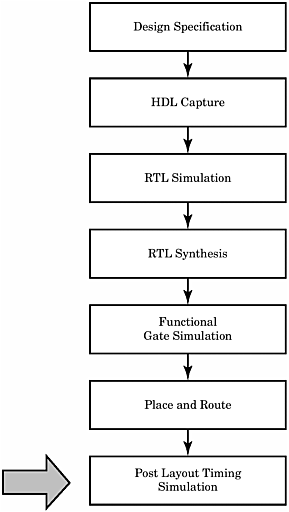
Within VHDL, this process is implemented using VITAL. VITAL is an IEEE standard that is used for modeling accurate timing at the gate level. VITAL is an acronym for the VHDL Initiative Toward ASIC Libraries. VITAL specifies a standard method of writing ASIC or FPGA libraries so that timing can be back-annotated. VITAL libraries used in concert with a VITAL-compliant VHDL simulator can perform gate-level timing simulation of the target design.
The VITAL process is shown in Figure 17-2.
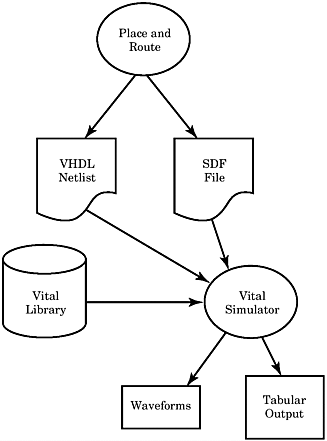
The place and route tools generate two VITAL-compliant simulator input files. The first is a VHDL netlist that contains the interconnections of all of the entities used to model the design. The second is a timing-accurate SDF back-annotation file used to input post-route timing into the VITAL simulation. There is a third input needed to the simulation process. The third input is the VITAL library that describes all of the behavior of the entities used to implement the design. In the next few sections, we examine each of...