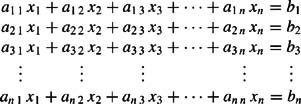
Circuit analysis via either the node or loop method involves the formulation and solution of a set of n linear algebraic equations in n unknowns, having the general form
where x 1 through x n are unknown node voltages (or mesh currents), a i j ( i, j = 1, 2, , n) are known admittances (or resistances), or b 1 through b n are known source voltages (or currents). Note that the double-subscript notation uses the first subscript to identify a row and the second subscript a column. The two most common methods of solving these equations are the Gaussian elimination method and Cramer's rule.
GAUSSIAN ELIMINATION
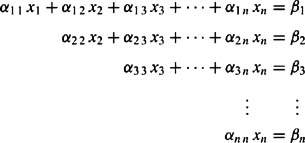
The Gaussian elimination technique repeatedly combines different rows in such a way as to transform the original system of equations into a system of the type
that is, into a system in which all coefficients with i > j are zero. This allows us to solve for x n directly, and to solve for x n ?1, x n ?2, , all the way down to x 1 successive back-substitutions. As an example, consider the following system of equations:
Multiplying the first equation through by ?2 and adding it pairwise to the second equation, and then multiplying the first equation through by 2/3 and adding it pairwise to the third equation, we obtain
Multiplying...
Copyright Oxford University Press, Inc. 1995 under license agreement with Books24x7

 TABLE OF CONTENTS