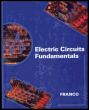
Electric Circuits Fundamentals

Chapter 7: Energy Storage Elements

OVERVIEW

The circuits examined so far are referred to as resistive circuits because the only elements used, besides sources, are resistances. The equations governing these circuits are algebraic equations because so are Kirchhoff's laws and Ohm's Law. Moreover, since resistances can only dissipate energy, we need at least one independent source to initiate any voltage or current in the circuit. In the absence of independent sources, all voltages and currents would be zero and the circuit would have no electrical life of its own.

It is now time we turn our attention to the two remaining basic elements, capacitance and inductance. The first distinguishing feature of these elements is that they exhibit time-dependent characteristics, namely, i = C( dv/ dt) for capacitance and v = L( di/ dt) for inductance. For this reason, capacitances and inductances are said to be dynamic elements. By contrast, a resistance is a static element because its i v characteristic does not involve time. Time dependence adds a new dimension to circuit behavior, allowing for a wider variety of functions as compared to purely resistive circuits.

The second distinguishing feature is that capacitances and inductances can absorb, store, and then release energy, making it possible for a circuit to have an electrical life of its own even in the absence of any sources. For obvious reasons, capacitances and inductances are also referred to as energy-storage elements.

The formulation of circuit equations...

UNLIMITED FREE
ACCESS
TO THE WORLD'S BEST IDEAS

SUBMIT
Already a GlobalSpec user? Log in.

This is embarrasing...

An error occurred while processing the form. Please try again in a few minutes.

Customize Your GlobalSpec Experience

Category: LCR Meters
Finish!
Privacy Policy

This is embarrasing...

An error occurred while processing the form. Please try again in a few minutes.