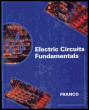
Electric Circuits Fundamentals

Chapter 9: Transient Response of Second-Order Circuits

OVERVIEW

In this chapter we turn our attention to second-order circuits, that is, circuits containing two energy-storage elements that cannot be reduced to a single equivalent element via series/parallel reductions. A second-order circuit may contain two capacitances, two inductances, or one of each. The last case is by far the most interesting because it may result in oscillatory behavior, a phenomenon found neither in first-order circuits nor in passive second-order circuits with two energy-storage elements of the same type. This phenomenon stems from the ability of energy to flow back and forth between the capacitance and the inductance, just as energy flows back and forth between the mass and the spring of a mechenical system.

We begin by formulating the differential equations governing the series RLC and the parallel RLC circuits, and we find that the roots of the characteristic equation and, hence, the natural response, are characterized in terms of two parameters known as the undamped natural frequency ? 0 and the damping ratio ?. Varying the damping ratio changes the location of the roots in the s plane as well as the damping characteristics of the response.

Overdamped responses consist of exponentially decaying terms similar to those of first-order circuits; however, underdamped responses consist of decaying oscillations, a feature unique to higher-order passive circuits with mixed energy-storage element types. When subjected to a step function, an under-damped circuit exhibits overshoot and ringing, phenomena not possible with...

UNLIMITED FREE
ACCESS
TO THE WORLD'S BEST IDEAS

SUBMIT
Already a GlobalSpec user? Log in.

This is embarrasing...

An error occurred while processing the form. Please try again in a few minutes.

Customize Your GlobalSpec Experience

Category: IC Electronic Filters
Finish!
Privacy Policy

This is embarrasing...

An error occurred while processing the form. Please try again in a few minutes.