Electric Circuits Fundamentals

14.6: NETWORK FUNCTION BUILDING BLOCKS

14.6 NETWORK FUNCTION BUILDING BLOCKS

Even though the frequency response can be calculated and plotted exactly, it is found that piecewise linear curve approximations are generally sufficient to convey the essential features of a response. The advantage of piecewise plots, also called idealized or linearized Bode plots, is that they can be drawn quickly and without the tedious computations required of exact plots. However, before dealing with a general method for drawing piecewise plots, we must learn to plot the basic building blocks of network functions.

Frequency-Invariant Functions

If a gain function is independent of frequency,


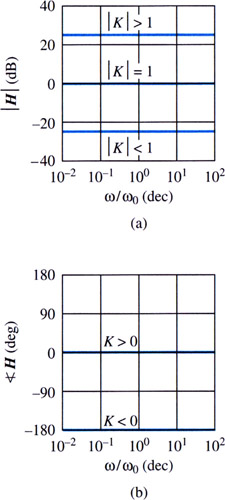
then its magnitude plot is a horizontal line positioned at 0 dB if K = 1, above 0 dB if K > 1, and below 0 dB if K < 1. Moreover, the phase plot is a horizontal line positioned at 0 if K is positive, or at 180 if K is negative. These plots are shown in Figure 14.28 (here we have chosen ?180 for negative K).


Figure 14.28: Bode plots of frequency-invariant functions.

Examples of circuits with constant gain functions are the ideal noninverting amplifier, for which H = 1 + R 2/ R 1 > 1; the ideal voltage follower, for which H = 1; and the voltage divider, for which H = R 2/( R 1 + R

UNLIMITED FREE
ACCESS
TO THE WORLD'S BEST IDEAS

SUBMIT
Already a GlobalSpec user? Log in.

This is embarrasing...

An error occurred while processing the form. Please try again in a few minutes.

Customize Your GlobalSpec Experience

Category: Active Low Pass Filters
Finish!
Privacy Policy

This is embarrasing...

An error occurred while processing the form. Please try again in a few minutes.