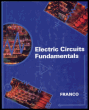
Electric Circuits Fundamentals

Chapter 8: Transient Response of First-Order Circuits

OVERVIEW

In Section 7.4 we found that the response to a dc forcing function consists of a transient component and a dc steady-state component. The transient component has the same functional form as the natural response, which is an exponentially decaying function. The dc steady-state component has the same functional form as the forcing function, which is a constant function. We now wish to apply the mathematical concepts of Sections 7.3 and 7.4 to a variety of circuit configurations, but with greater attention to physical behavior. An engineer must always use physical insight to interpret mathematical results!

In the present chapter we concentrate on first-order circuits, that is, circuits that contain only one energy-storage element or that contain multiple elements, but in such a way that they can be reduced to a single equivalent element via series/parallel combinations. In Chapter 9 we turn our attention to second-order circuits, with special emphasis on circuits that contain one capacitance or one inductance.

We begin by examining in great physical detail how energy builds up and decays in simple capacitive and inductive circuits. In so doing, we develop a set of useful rules to facilitate the transient analysis of more complex networks.

Next, we study the step and pulse responses of the basic R-C, L-R, C-R, and R-L circuits, and observe how these circuits behave in terms of signal distortion as well as passing or blocking the dc component of an input pulse train.

We then...

UNLIMITED FREE
ACCESS
TO THE WORLD'S BEST IDEAS

SUBMIT
Already a GlobalSpec user? Log in.

This is embarrasing...

An error occurred while processing the form. Please try again in a few minutes.

Customize Your GlobalSpec Experience

Category: Transient Voltage Suppressor Diodes (TVS)
Finish!
Privacy Policy

This is embarrasing...

An error occurred while processing the form. Please try again in a few minutes.