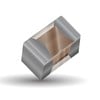
As a rule, you should always specify standard resistance values for the circuits you design (see Table A.1). In many applications 5% resistors are adequate; however, when a higher precision is required, 1% resistors should be used. When even this tolerance is insufficient, the alternatives are either 0.1% (or better) resistors, or less precise resistors in conjunction with potentiometers to allow for exact adjustments.
The numbers in the table are multipliers. As an example, suppose your calculations indicate the need for a resistance value of 3.1415 k ?. Then, Table A.1 indicates that the closest usable resistance in the 5% tolerance range is 3 k ?, while the closest 1% resistance is 3.16 k ?.
The facilitate the identification of their values and tolerance, resistors are often equipped with multicolored bands as shown in Figure A.1. The numerical values associated with these bands are shown in Table A.2. Bands x, y, and z give the nominal resistance value, while the percentage band gives the maximum percentage deviation from this value. The rule for calculating a resistance value from its color bands is
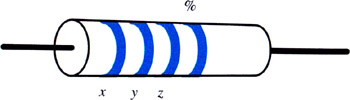 Figure A.1: Color coding for resistors.
 Table A.1: Standard Resistance Values | 5 percent resistor values | 1 percent resistor values |
| 10 | 100 | 178 | 316 | 562 |
| 11 | 102 | 182 | 324 | 576 |
| 12 | 105 | 187 | 332 | 590 |
| 13 | 107 | 191 | 340 | 604 |
| 15 | 110 | 196 | 348 | 619 |
| 16 | 113 | 200 | 357 | 634 |
| 18 | 115 | 205 | 365 | 649 |
| 20 | 118 | 210 | 374 | 665 |
| 22 | 121 | 215 |
Copyright Oxford University Press, Inc. 1995 under license agreement with Books24x7


 TABLE OF CONTENTS