Electric Circuits Fundamentals

In this section we investigate complex exponential signals, and in so doing we introduce the important concepts of complex frequency s, generalized impedance Z( s), and s-domain analysis. Our primary reason for studying circuit response to signals of this sort is not the response per se, but an important by-product known as the network function. This function, which is investigated in the following sections, constitutes a cornerstone concept in circuit theory because it contains all essential information about a circuit.
A complex exponential signal is a signal of the type
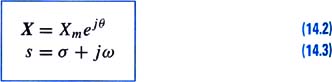
where X and s are time-independent complex parameters expressed, respectively, in polar and rectangular coordinates as
In these expressions,
| X m | is the magnitude of x( t), expressed either in V or in A |
| ? | is the phase angle, either in radians or in degrees |
| ?, | the real part of s, is called the neper frequency and is expressed in nepers/s (Np/s) |
| ?, | the imaginary part of s, is called the radian frequency and is expressed in radians/s (rad/s) |
We observe that X = X m/ ? ? is a phasor. Moreover, since s is a complex quantity with ? as its imaginary part, it is called the complex frequency. Its units are complex nepers per second (complex Np/s). Substituting the expression for X