14.2 NETWORK FUNCTIONS
In spite of its simplicity, the illustrative example of the previous section has evidenced important features that hold for circuits with energy-storage elements in general, regardless of their complexity. We now wish to generalize our observations.
Given a network made up of resistances, capacitances, inductances, and possibly dependent sources, the applied signal x( t) and the response y( t) are in general related by a linear differential equation of the type
where a 0 through a m and b 0 through b n are suitable coefficients whose expressions depend on the elements comprising the network and are thus real and time-independent.
With an applied signal of the complex exponential type
the response is also of the complex exponential type
and the value of s in the expression for y( t) is the same as that given in the expression for x( t). Substituting x and y into Equation (14.23) and exploiting the important exponential property
we obtain
Eliminating the common term e st, this can be abbreviated as
where D( s) and N( s) are polynomials in s with real coefficients,
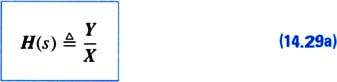
and n and m are their degrees. These polynomials are, respectively, the left and right members of Equation (14.23), but with derivatives replaced by powers of s. Solving Equation (14.27) for the ratio
generally...

 TABLE OF CONTENTS