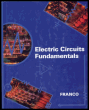
Electric Circuits Fundamentals

Chapter 4: Circuit Theorems and Power Calculations

OVERVIEW

In this chapter we study one-ports, a class of circuits equipped with a terminal pair through which signals and energy may enter or leave the circuit. A one-port is uniquely characterized by the current voltage relationship at its terminals, called the i ? v characteristic. We are interested in one-ports made up of sources and resistances, because their i ? v characteristics are straight lines, just like the characteristics of practical voltage and current sources. In fact, we can extend the concept of equivalence and say that in terms of the i ? v relationship at its terminals, a linear one-port can be modeled either with an ideal voltage source and a suitable series resistance or with an ideal current source and a suitable parallel resistance. These statements form the essence of the fundamental circuit theorems known, respectively, as Th venin's and Norton's theorems.

The ability to model a one-port with just a source and a resistance has far-reaching implications in circuit analysis and design. A complex circuit can often be broken down into separate one-port subcircuits that, on paper at least, can be replaced with their Th venin or Norton equivalents to facilitate finding the voltages or currents at the common terminal pairs.

In this chapter we first show how to find the Th venin and Norton equivalents of a one-port. We then apply these equivalents to the analysis of a variety of linear and nonlinear circuits. In the course of nonlinear analysis we introduce iterative...

UNLIMITED FREE
ACCESS
TO THE WORLD'S BEST IDEAS

SUBMIT
Already a GlobalSpec user? Log in.

This is embarrasing...

An error occurred while processing the form. Please try again in a few minutes.

Customize Your GlobalSpec Experience

Category: Curve Tracers
Finish!
Privacy Policy

This is embarrasing...

An error occurred while processing the form. Please try again in a few minutes.