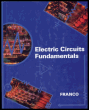
Electric Circuits Fundamentals

Chapter 12: AC Power and Three-Phase Systems

OVERVIEW

In this chapter we apply phasor techniques to the study of ac power and three-phase (3- ?) systems, the most widely used power generation and distribution systems. Our interest in ac power stems from a variety of reasons. First, electrical power is most efficiently and economically generated, transmitted, and distributed in ac form. Second, all electrical and electronic devices and systems have power ratings that must not be exceeded if satisfactory operation is desired. Finally, power is a precious resource, and whether we are designers or users of electrical equipment, it is our responsibility to strive for an efficient utilization of this resource. After all, ac power forms the basis of our monthly bill from the electric utility company. Depending on the application, the amount of power involved may range from a few picowatts (1 pW = 10 ?12 W) as in telecommunication signals, to several gigawatts (1 GW = 10 9 W) as in large power-generating plants. This is an amazingly wide range of values!

We begin by examining the transfer of power from an ac source to a load impedance and find that the average power, which is the type of power of greatest practical interest, depends not only on the magnitudes of the voltage and current but also on their phase difference. Moreover, power transfer is maximized when the load impedance is made equal to the complex conjugate of the impedance of the source, a...

UNLIMITED FREE
ACCESS
TO THE WORLD'S BEST IDEAS

SUBMIT
Already a GlobalSpec user? Log in.

This is embarrasing...

An error occurred while processing the form. Please try again in a few minutes.

Customize Your GlobalSpec Experience

Category: Power Supplies
Finish!
Privacy Policy

This is embarrasing...

An error occurred while processing the form. Please try again in a few minutes.