OVERVIEW
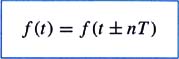
As we know, a periodic function is a function that satisfies the property
for any t and n = 1, 2, 3, , where T is the period, in seconds. The most common periodic functions are sin ? t, cos ? t, and e j ? t, which are the building blocks of ac signals and complex exponential signals.
There are, however, many other periodic functions of sufficient practical importance to warrant our attention. The first examples to come to our mind are the triangle, rectangle, sawtooth, and pulse-train waves produced by function generators in the laboratory for testing and control. Also periodic is the waveform produced by the sweep generator controlling the electron beam of a cathode-ray tube of the type found in oscilloscopes and television sets. The clock generator controlling the sequence of operations in personal computers, pocket calculators, and wristwatches produces a periodic pulse train. Electrical power, generated in approximately sinusoidal form at the source, is subsequently processed by nonlinear devices such as rectifiers and practical transformers and motors, which distort the original wave, either intentionally or unintentionally, to yield nonsinusoidal waveforms that are nevertheless still periodic. Other examples of nearly periodic signals are the output of a microphone in response to a sustained musical note and the heart signal displayed by an electrocardiograph.
Periodic functions are important also in nonelectrical phenomena such as mechanical vibrations, fluid flow,...

 TABLE OF CONTENTS