
Switch / Relay Input Temperature Controllers
Last Updated: April 1, 2025
Description
Switch/Relay Input Temperature Controllers are devices designed to regulate temperature by controlling the operation of heating or cooling equipment. They achieve this by receiving input from temperature sensors and using that data to activate or deactivate relays or switches, which in turn control the power supply to the equipment.
Working Principle
These controllers operate by receiving temperature data from sensors such as thermocouples or RTDs. Based on the input, the controller compares the actual temperature to the desired setpoint. If the temperature deviates from the setpoint, the controller activates a relay or switch to adjust the power supply to the heating or cooling device, thereby bringing the temperature back to the desired level. This mechanism is useful because it provides precise temperature control, ensuring that processes remain within specified limits, which is crucial for maintaining product quality and safety in industrial applications.
Applications
Switch/Relay Input Temperature Controllers are used in a variety of specific applications. For instance, they are employed in the operation of heat pumps, electronic cooling fans, and low voltage relays that actuate motor starters and igniters for oil burners. They are also used in heavy-duty switches for electrical units and solenoid-operated valves on gas furnaces .
Advantages over other Temperature Controllers
One advantage of these controllers is their cost-effectiveness. Simple controllers with relay outputs are less expensive to implement in a system compared to those with more complex outputs like SSR (Solid State Relay) outputs . Additionally, bimetal switches, a type of relay input temperature controller, are known for their low cost, toughness, and ease of use and installation .
Limitations
A significant limitation of relay input temperature controllers is their mechanical wear, which limits how often they can switch. This makes them less suitable for applications requiring frequent switching, where SSR outputs might be more appropriate . Additionally, bimetal switches, while cost-effective, are not as accurate as other types of temperature sensors, such as glass stem thermometers .
Considerations
When selecting a switch/relay input temperature controller, several factors should be considered. Initial costs are generally lower for simple relay output controllers, but operating expenses may increase due to mechanical wear and the need for more frequent maintenance or replacement. Durability is a strong point for bimetal switches, but accuracy might be compromised compared to other sensor types. It's also important to consider the specific requirements of the application, such as the need for faster switching or more precise control, which might necessitate a more advanced controller with SSR outputs .

from Florite International, Inc.
The 900 Series is an economic one loop microcomputer-based instrument incorporating user selectable digital and analog inputs, as well as analog and relay outputs. Other 900 Series features include .005% high accuracy PID, batch, and dose control functions. Additionally, the 900 Series encompasses... [See More]
- Type: DC Voltage Inputs; Current Loop (Transmitter) Excitation; Resistive/ Potentiometer Inputs; Switch / Relay Input; Frequency Inputs; Serial / Digital Input; Fieldbus / Network Input; Screw Terminal
- Control: Limit; Linear; Feedforward; PID
- Controller Type: Laboratory
- Features: PLC; Multi-Function; Datalogger; Is a Chart Recorder; Rate Indication/ Control; Totalizing (Length or Roll Diameter) Indication/ Control
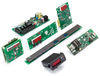
from Selco Products Company
For applications where high precision temperature control is required and where time and/or temperature reading must be displayed, these electronic controls offer an advanced solution over standard electro-mechanical component thermostats. Selco offers high-end electronic features to provide... [See More]
- Type: Switch / Relay Input
- Interface: Switches; Digital Front Panel
- Form Factor: Board; Stand-Alone
- Inputs: 3

from Distech Controls, Inc.
Roof top & heat pump applications, 2 digital inputs (software configurable) [See More]
- Type: Switch / Relay Input; Serial / Digital Input; Relay Dry Contact
- Features: Multi-Function
- Control: PID
- Form Factor: Chassis; DIN

from Russells Technical Products
Russells BlueStar ™ color touch screen controller is a powerful state of the art chamber controller/microprocessor that makes programming your test chamber a breeze. Take control of your Russells chamber with a touch of the finger. BlueStar ™ is packed with features that you would not... [See More]
- Type: DC Voltage Inputs; Current Loop (Transmitter) Excitation; Switch / Relay Input; Fieldbus / Network Input
- Features: Datalogger; Is a Chart Recorder; Rate Indication/ Control; Totalizing (Length or Roll Diameter) Indication/ Control; PC-Based
- Control: Limit
- Form Factor: Stand-Alone