
Unguided/Externally Guided Rodless Cylinders
Last Updated: April 1, 2025
Description
Unguided or externally guided rodless cylinders are pneumatic devices designed to move loads along a linear path without the use of an internal guide. Instead, they rely on external hardware to direct their motion. These cylinders are typically used in applications where the guidance and support of the load are managed by separate components, allowing for greater flexibility in system design.
Working Principle
Unguided rodless cylinders operate by using a piston that moves within a sealed cylinder. The motion of the piston is transferred to an external carriage, which carries the load. The carriage is not mechanically attached to the piston but is instead moved by a magnetic coupling. This design prevents contaminants from entering the cylinder, making it suitable for environments where cleanliness is crucial. The magnetic coupling also allows for easy re-coupling of the carriage to the piston, which is beneficial for maintenance and adjustments. These cylinders are useful because they provide a compact solution for linear motion, reducing the need for additional space that would be required by traditional rod-style cylinders.
Applications
Unguided rodless cylinders are often used in applications where the load needs to be moved over long distances with precision. Specific examples include automated assembly lines where components need to be transported between stations, or in packaging machinery where products are moved through various stages of the packaging process. They are also used in material handling systems, such as conveyor systems, where the external guidance can be customized to fit the specific requirements of the load being transported.
Advantages over other Rodless Cylinders
One of the main advantages of unguided rodless cylinders is their flexibility in system design. Since the guidance is provided externally, these cylinders can be integrated into systems where space is limited or where the load requires specific handling that an internal guide cannot provide. Additionally, the magnetic coupling mechanism offers a clean and efficient way to transfer motion without the risk of contamination, which is a significant advantage in industries that require high levels of hygiene.
Limitations
A notable limitation of unguided rodless cylinders is their reliance on external guidance systems, which can add complexity and cost to the overall system design. Additionally, the magnetic coupling can become uncoupled at high speeds or during hard deceleration, which may limit their use in high-speed applications. The initial cost of these cylinders can also be higher compared to other types due to the need for precise magnetic components.
Considerations
When considering the use of unguided rodless cylinders, it is important to evaluate the initial costs, which can be higher due to the need for external guidance systems and magnetic coupling components. Operating expenses may also be influenced by the maintenance of the external guidance hardware. Durability and accuracy are generally high, but they depend on the quality of the external guidance system. Replacement and maintenance costs should be considered, especially in environments where the external guidance system is subject to wear and tear. Proper alignment and installation are crucial to ensure optimal performance and longevity of the system.
from Tolomatic
Cylinders can be isolated from any work area with extended cable lengths [See More]
- Cylinder Configuration: Unguided/Externally Guided
- Operating Pressure: 0.0 to 100
- Stroke: 20.4
- Bore Size: 0.5000
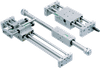
from ASCO
The MCR Series cylinder consists of a piston and a carriage, which are coupled together using rare earth magnets. When the cylinder is pressurized from one end, the piston will travel the length of the tube, which in turn moves the carriage. Pressurizing the other side the carriage will travel back... [See More]
- Cylinder Configuration: Unguided/Externally Guided
- Rated Load/Force: 195
- Stroke: 0.0 to 100
- Operating Pressure: 100

from Tolomatic
Option of auto tensioner with one or two 1" stroke units [See More]
- Cylinder Configuration: Unguided/Externally Guided
- Operating Pressure: 0.0 to 100
- Stroke: 126
- Bore Size: 1.5

from ASCO
The NR Series rodless offers an alternative solution to conventional cylinder applications. It's compact design cuts space requirement by 50% compared to rodded cylinders. Additionally, the extruded tube construction requires fewer supports than other cylinders. Dual air supply at one end eliminates... [See More]
- Cylinder Configuration: Unguided/Externally Guided
- Operating Pressure: 145
- Stroke: 0.0 to 234
- Bore Size: 0.9843 to 1.97

from Tolomatic
Double the velocity and stroke capacity of double-acting cylinders [See More]
- Cylinder Configuration: Unguided/Externally Guided
- Operating Pressure: 0.0 to 100
- Stroke: 126
- Bore Size: 1.5

from Tolomatic
No mechanical piston connection, actuator block can be easily rotated [See More]
- Cylinder Configuration: Unguided/Externally Guided
- Operating Pressure: 0.0 to 100
- Stroke: 26
- Bore Size: 0.2500

from Tolomatic
Ideal for vertical lifting applications [See More]
- Cylinder Configuration: Unguided/Externally Guided
- Operating Pressure: 0.0 to 100
- Stroke: 20.4
- Bore Size: 0.7500