
Mechanical Interlock Industrial Joysticks
Description
Mechanical Interlock Industrial Joysticks are devices designed to ensure that a plug cannot be engaged or disengaged under load. They incorporate switchable pins that provide a mechanical safety feature, preventing accidental or unauthorized operation.
Working Principle
Mechanical interlock joysticks operate by using switchable pins that lock into place, ensuring that the joystick cannot be moved unless certain conditions are met. This mechanism is crucial for safety, as it prevents the joystick from being operated under potentially hazardous conditions. The interlock feature is particularly useful in environments where safety is paramount, as it provides a physical barrier to unintended operation.
Applications
Mechanical Interlock Industrial Joysticks are commonly used in environments where safety is a critical concern. For example, they are employed in heavy machinery operations where accidental activation could lead to dangerous situations. They are also used in industrial settings where equipment must be securely locked in place to prevent unauthorized use or accidental engagement.
Advantages over other Industrial Joysticks
Mechanical interlock joysticks offer a significant safety advantage over other types of industrial joysticks due to their physical locking mechanism. This feature ensures that the joystick cannot be operated unless specific safety conditions are met, reducing the risk of accidents. Additionally, the mechanical interlock provides a clear and reliable method of preventing unauthorized use, which is not always possible with electronic or software-based safety features.
Limitations
One limitation of mechanical interlock joysticks is that they can be more challenging to clean thoroughly, especially in environments where dust and liquids are present. The mechanical components may also be subject to wear and tear over time, potentially requiring more frequent maintenance compared to non-contact or electronic joysticks.
Considerations
When considering mechanical interlock joysticks, it is important to evaluate the initial costs, which may be higher due to the complexity of the mechanical interlock system. Operating expenses can also be a factor, as the mechanical components may require regular maintenance to ensure proper functioning. Durability is generally high, but the mechanical nature of the interlock means that parts may need to be replaced more frequently than in non-contact systems. Accuracy is typically reliable, but it is essential to ensure that the interlock mechanism is functioning correctly to maintain safety standards.
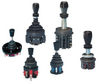
from Euchner-U.S.A., Inc.
EUCHNER Industrial Joysticks are manually actuated motion control switches. They are used on equipment that requires operator control of one or more axis. Features such as multiple switches per direction, interlocks, pushbuttons, mounting plates and bellows offer our customers a wide variety of... [See More]
- Number of Actuations: 1x10⁶ Operating Cycles
- Switches: Friction Hold; Spring Return (Centering)
- Number of Actuating Directions: 1 to 8
- Switching Elements: Normally Open; Normally Closed (optional feature); Changeover (optional feature)

from Ultra Electronics Measurement Systems Inc
This model is a single axis proportional joystick with spring return-to-center using a 5K ohm center tapped potentiometer whose electrical angle matches the mechanical angle of the joystick. Stay in place versions with direction switches. [See More]
- Number of Axes: 1-Axis Control; 3-Axis Control (optional feature)
- Switches: Friction Hold; Spring Return (Centering) (optional feature)
- Number of Actuating Directions: 2
- Joystick Application: Precision Joystick Controller

from Ultra Electronics Measurement Systems Inc
This rugged controller can be actuated in eight separate directions. The handle normally returns to center off position, but when desired, a turn of the knurled tip will lock the handle in any position. Switches are SPST-NO, snap action. Rating: 5 amp at 28 VDC Ind. [See More]
- Number of Axes: 2-Axis Control; 4-Axis Control (optional feature)
- Switches: Friction Hold; Spring Return (Centering)
- Number of Actuating Directions: 8
- Joystick Application: Precision Joystick Controller