
RS232 Machine Controllers and Monitors
Description
RS232 Machine Controllers and Monitors are devices that facilitate the control and monitoring of computerized machinery through electronic numeric interfaces. They are designed to connect and communicate with various types of equipment using the RS-232 serial communication standard, which is widely recognized for its role in data exchange between computers and peripheral devices.
Working Principle
RS232 Machine Controllers and Monitors operate on the RS-232 standard, which is a single-ended, full-duplex interface designed for point-to-point communication. This means that each controller or monitor connects directly to a single device, allowing for the exchange of data. The RS-232 interface uses high signal amplitudes to gain noise immunity, with logic levels defined by specific voltage ranges. This setup is particularly useful for ensuring reliable data transmission in environments where electrical noise might otherwise interfere with communication.
Applications
RS232 Machine Controllers and Monitors are used in a variety of applications across different industries. For example, in the automotive industry, they can be used to program and calibrate machinery involved in the manufacturing process. In the aerospace sector, these devices might be employed to monitor and control equipment used in the assembly of aircraft components. Additionally, they are commonly used in industrial settings for the real-time control of multiple drives in automation applications.
Advantages over other Machine Controllers and Monitors
One of the primary advantages of RS232 Machine Controllers and Monitors is their widespread availability and compatibility with existing systems. The RS-232 standard is one of the most prolific communication ports, making it easier to integrate these devices into existing setups without the need for extensive modifications. Additionally, RS232 interfaces do not suffer from the flow issues that can affect other standards, such as RS485, making them a reliable choice for many applications.
Limitations
Despite their advantages, RS232 Machine Controllers and Monitors have some limitations. The RS-232 standard is rated for data communication at speeds below 20,000 bits per second and distances up to 50 feet, which can be limiting in applications requiring higher speeds or longer distances. Furthermore, the standard's reliance on a single-ended communication method can make it more susceptible to electrical noise compared to differential systems like RS422 or RS485.
Considerations
When selecting RS232 Machine Controllers and Monitors, several factors should be considered. Initial costs can vary depending on the specific features and capabilities of the device. Operating expenses may be influenced by the need for additional equipment, such as converters, to extend communication distances or improve noise immunity. Durability and accuracy are generally high, but regular maintenance and potential replacement costs should be factored into the overall cost of ownership. Additionally, the compatibility of the RS-232 interface with existing systems can significantly impact the ease of integration and long-term viability of the solution.
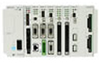
from Yaskawa America, Inc. - Motion Division
Up to 256 Axes. The MP2200 expands the MP2300's capabilities to a rack system of 9 slots and up to 256 axes of motion control while maintaining the same position, speed, torque and phase control as well as electronic camming ability. [See More]
- Communication: DeviceNet; Ethernet; PROFIBUS; RS232; RS422; RS485; USB; Mechatrolink
- DC Input: 24
- Form Factor: Desktop, Stand Alone or Tower
- Input: DC Input
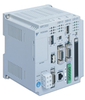
from Yaskawa America, Inc. - Motion Division
Up to 48 Axes. The MP2300 synchronizes sequence control and motion control in one tightly integrated platform. Position, speed, torque, and phase control such as electronic gearing and electronic cam profiles are available for a variety of applications. [See More]
- Communication: DeviceNet; Ethernet; PROFIBUS; RS232; RS422; RS485; Mechatrolink
- AC Input: 85 to 276
- Form Factor: Desktop, Stand Alone or Tower
- DC Input: 24

from MECCO
The smartbox controller is the latest generation controller for our pin marking equipment. It is available in two configurations: the keypad with 7" color screen or the 10" color touchscreen. This autonomous control system does not require a PC for operation, and it is possible to manage multiple... [See More]
- Communication: Ethernet; PROFIBUS; RS232
- AC Input: 110 to 220
- Form Factor: Panel Mount; Rack Mount
- Phase : Single Phase

from Nutfield Technology
The Pipeline-1 Scan C ontroller incorporates the SurfBoard-1, power supply, signal interface board and other components in a 19-inch 1U rack mount enclosure. A front panel key switch with 5-second delay, mark in progress indicator, and safety interlock loop are provided. The interface board... [See More]
- Communication: RS232; USB
- DC Input: 5 to 24
- Form Factor: Rack Mount
- Input: Analog Input

from Opto 22
Opto 22 Modular Controller designed for use with FactoryFloor software. [See More]
- Communication: ARCnet (optional feature); Ethernet (optional feature); RS232; RS422; RS485
- DC Input: 5 to 24
- Form Factor: Desktop, Stand Alone or Tower
- Main Memory: 1.00E-3 to 0.2560

from HydraForce, Inc.
The ECU-ML Machine Control is a heavy-duty general-purpose programmable controller designed to withstand the extreme environmental demands of the agricultural, marine, mining and construction industries. Based on a 32-bit MPC555. microprocessor running at 40MHz, the ECU-ML is a monitor and... [See More]
- Communication: CANbus; RS232
- DC Input: 9 to 32
- Form Factor: Desktop, Stand Alone or Tower
- Input: Analog Input; Frequency or Pulse; Interrupt Input; Analog, PWM, Resistance
from STW Technic
Developed especially for use with harsh conditions and extreme temperatures [See More]
- Communication: CANbus; RS232; Pulse Width Modulation
- DC Input: 9 to 32
- Form Factor: Panel Mount
- Input: DC Input; Frequency or Pulse; Interrupt Input

from MECCO
The T2 Controller is the time-tested, industrial strength electric controller for COUTH marking machines. The T2 controller embodies the best properties of all previous COUTH marking system control units and incorporates cutting-edge superior technology. As a result, it is the most flexible and... [See More]
- Communication: Ethernet; PROFIBUS; RS232; RS485
- AC Input: 110 to 220
- Form Factor: Desktop, Stand Alone or Tower
- Phase : Single Phase
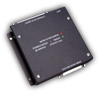
from Nutfield Technology
Nutfield Technology ’s SurfBoard-1 USB scan controller coordinates any laser with a 2-axis or 3-axis galvo scanning system. Hardware I/O can be configured to interact with other devices for handshaking and synchronizing functions, and can control motion devices such as XY tables and rotary... [See More]
- Communication: RS232; USB
- DC Input: 5 to 24
- Form Factor: DIN Rail
- Input: Analog Input

from Opto 22
Opto 22 Modular Controller is designed for use with FactoryFloor software. [See More]
- Communication: ARCnet (optional feature); Ethernet (optional feature); RS232; RS422; RS485
- DC Input: 5 to 24
- Form Factor: Desktop, Stand Alone or Tower
- Input: Analog Input; Digital, Multifunction

from Nutfield Technology
The SurfBoard-2 Scan Controller includes SurfBoard-1 capabilities adding Ethernet, dedicated stepper motor output, analog and digital I/O, and on-board flash hardware for Standalone/Flash operation. The SurfBoard-2 scan controller coordinates any laser with a 2-axis or 3-axis galvo scanning system. [See More]
- Communication: Ethernet; RS232; USB
- DC Input: 5 to 24
- Form Factor: DIN Rail
- Input: Analog Input; Transistor Input
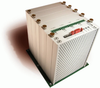
from Opto 22
SNAP Modular M4 Controller for FactoryFloor systems [See More]
- Communication: RS232; RS485
- DC Input: 5
- Form Factor: Desktop, Stand Alone or Tower
- Main Memory: 4