
Spiral Teeth Helical Gears
Last Updated: April 1, 2025
Description
Spiral teeth helical gears are a type of gear used to transmit torque between shafts that are not parallel and do not intersect. These gears are characterized by their spiral-shaped teeth, which allow for smooth and gradual engagement between the gears.
Working Principle
Spiral teeth helical gears operate by engaging their angled teeth gradually, starting from one end of the gear tooth and increasing as the gears rotate until fully engaged. This design allows for a greater load-carrying capacity because more gear teeth share the load at any given time, resulting in lower stress and reduced wear on the gears. The unique configuration of spiral gears, with two circular pitches and two pitch surfaces, enables them to rotate about their own axis while the pitch plane travels in the direction of rotation of the mating gear. This gradual engagement also results in smoother and quieter operation compared to other gear types.
Applications
Spiral teeth helical gears are commonly used in applications where shafts are at right angles to each other. They are particularly useful in situations where smooth and quiet operation is essential, such as in automotive transmissions and industrial machinery where noise reduction is a priority.
Advantages over other Helical Gears
Spiral teeth helical gears offer smoother and quieter operation compared to straight bevel gears due to their gradual engagement and the spiral design of the teeth. This makes them particularly advantageous in applications where noise reduction is critical.
Limitations
One of the primary limitations of spiral teeth helical gears is their susceptibility to excessive wear due to point contact, which can lead to high compressive stresses at the contact point. This wear is more pronounced under lighter loads, and the gears require careful running-in under increasing loads to develop a polished band on the teeth surfaces, which can then handle higher loads without excessive wear.
Considerations
When considering spiral teeth helical gears, it is important to account for the initial costs associated with their complex machining and finishing processes. Operating expenses may also be higher due to the need for regular maintenance and lubrication to manage the dynamic friction on the gear surfaces. Additionally, the axial thrust produced by these gears requires the use of thrust bearings to prevent misalignment, which can add to the overall cost and complexity of the system. Durability and accuracy are generally high, but replacement and maintenance costs can be significant due to the specialized nature of these gears.

from ATLANTA Drive Systems, Inc.
Welcome to the widest range of standard racks & pinions in the World! Consisting of both helical & straight (spur) tooth versions, in an assortment of sizes, materials and quality levels, to meet almost any axis drive requirements. These drives are perfect for a wide range of applications,... [See More]
- Tooth Form: Spiral
- Design: Metric
- Number of Teeth: 26
- Direction: Left
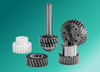
from ATLANTA Drive Systems, Inc.
Welcome to the widest range of standard racks & pinions in the World! Consisting of both helical & straight (spur) tooth versions, in an assortment of sizes, materials and quality levels, to meet almost any axis drive requirements. These drives are perfect for a wide range of applications,... [See More]
- Tooth Form: Spiral
- Design: Metric
- Number of Teeth: 30
- Direction: Left