
Hub Helical Gears
Last Updated: April 1, 2025
Description
Hub helical gears are a type of gear system characterized by their angled teeth, which are cut into the gear's cylindrical surface. These gears are designed to transmit torque between shafts that are either parallel or perpendicular to each other. The hub of the gear is typically attached to a shaft using various methods such as hub clamping screws, split hubs, or simple bores, ensuring a secure fit around the shaft.
Working Principle
Helical gears operate by engaging their angled teeth gradually as the gears rotate. This gradual engagement allows for a smoother and quieter operation compared to gears with straight teeth, such as spur gears. The angled teeth also enable helical gears to carry greater loads because more teeth are in contact at any given time, distributing the load more evenly and reducing stress on individual teeth. However, the angled contact surfaces generate axial thrust loads, which must be countered with thrust bearings to prevent misalignment.
Applications
Helical gears are versatile and can be used in a variety of applications. They are commonly found in automotive transmissions, where their smooth operation and load-carrying capacity are advantageous. They are also used in conveyor systems, elevators, and other machinery that requires reliable torque transmission between shafts. Specific examples include their use in gearboxes for industrial machinery and in the drive systems of wind turbines.
Advantages over other Helical Gears
Helical gears offer several advantages over other types of gears. They can bear greater loads than spur gears due to their angled teeth, which allow for more teeth to be engaged simultaneously. This results in quieter operation and less wear over time. Additionally, helical gears are more versatile, as they can be used in both parallel and right-angle configurations, providing a wider range of gear ratios and shaft distances.
Limitations
One of the main limitations of helical gears is the complexity involved in their machining and finishing, which can lead to higher maintenance costs. The axial thrust generated by the angled teeth requires the use of thrust bearings, adding to the system's complexity and potential points of failure. If not properly managed, this thrust can cause misalignment and increased wear.
Considerations
When considering the use of hub helical gears, several factors should be taken into account. Initial costs can be higher due to the complexity of manufacturing and the need for precise alignment. Operating expenses may also be elevated due to the requirement for thrust bearings and high-pressure lubricants to manage axial thrust. However, the durability and accuracy of helical gears can offset these costs over time, as they tend to wear less and operate more quietly than other gear types. Replacement and maintenance costs should also be considered, as the need for specialized components like thrust bearings can increase these expenses.
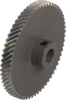
from Ondrives.US Corporation, formerly Rino Mechanical
Helical cut gears are similar to spur gears with their teeth cut at an angle. The most popular helical gear design is 45 degrees. Helical cut gears can have a right hand or a left hand gear helix. When 45 ° helical gears of the opposite hand operate together they will turn parallel shafts in... [See More]
- Mounting: Hub
- Design: English
- Number of Teeth: 10 to 160
- Features: Anti-backlash

from ATLANTA Drive Systems, Inc.
We have recently expanded our range of ISO 9409-1-A flanged pinions. This allows the machine designer the flexibility of choosing the best flanged pinion to meet the application needs. The new TR flanged pinions have compact designs to reduce the amount of drive torque required. Traditionally,... [See More]
- Mounting: Hub; Flange
- Design: Metric
- Number of Teeth: 12
- Direction: Left

from ATLANTA Drive Systems, Inc.
Welcome to the widest range of standard racks & pinions in the World! Consisting of both helical & straight (spur) tooth versions, in an assortment of sizes, materials and quality levels, to meet almost any axis drive requirements. These drives are perfect for a wide range of applications,... [See More]
- Mounting: Hub; Keyway
- Design: Metric
- Number of Teeth: 21
- Direction: Left