
60-40 Scratch / Dig Polarizing Cube Beamsplitters
Last Updated: February 12, 2025
Description
60-40 Scratch / Dig Polarizing Cube Beamsplitters are optical components designed to split a beam of light into two separate beams with different polarizations. They are constructed by cementing together two precision right angle prisms with a dielectric coating on the hypotenuse surface. This design allows them to transmit p-polarized light while reflecting s-polarized light, effectively separating the two polarizations.
Working Principle
The working principle of polarizing cube beamsplitters involves the use of dielectric coatings to achieve polarization separation. When a randomly polarized beam of light enters the cube, the dielectric coating on the diagonal surface selectively transmits p-polarized light and reflects s-polarized light. This separation is achieved due to the difference in reflection and transmission properties of the coating for different polarizations. These beamsplitters are particularly useful in applications requiring precise control over light polarization, such as in laser optics, where they help in directing and manipulating laser beams with minimal loss.
Applications
Polarizing cube beamsplitters are widely used in laser optics, where they are employed to manage and direct laser beams in systems requiring specific polarization states. They are also utilized in optical instrumentation and imaging systems to enhance contrast and reduce glare by controlling the polarization of light. Additionally, they find applications in telecommunications and photonics for signal processing and polarization management.
Advantages over other Polarizing Cube Beamsplitters
One of the advantages of 60-40 Scratch / Dig Polarizing Cube Beamsplitters is their ability to handle high power laser beams with minimal degradation over time, provided they are correctly oriented. The precision construction using right angle prisms and dielectric coatings ensures high efficiency in polarization separation, making them suitable for demanding optical applications.
Limitations
A specific limitation of these beamsplitters is their requirement for collimated light beams. Only collimated beams can be effectively used with polarizing cube beamsplitters, which may necessitate additional components like shear plates to ensure proper beam collimation. Additionally, incorrect orientation can lead to increased energy passing through the optical cement, potentially degrading the cement over time, especially when used with high power light sources.
Considerations
When considering the use of 60-40 Scratch / Dig Polarizing Cube Beamsplitters, it is important to factor in initial costs, which can be significant due to the precision manufacturing involved. Operating expenses are generally low, but maintenance costs can arise if the beamsplitters are not properly oriented or if they are exposed to high power beams without adequate cooling. Durability is high when used within specified parameters, but accuracy in polarization separation can be affected by improper handling or alignment. Replacement and maintenance costs should be considered in environments where high power or non-collimated beams are prevalent, as these factors can lead to premature wear or failure.
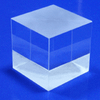
from CeNing Optics Co., Ltd.
The beam splitter cubes are constructed by cemented two matched right angle prisms. The hypotenuse is coated with partial dielectric coating. Easy to mount, is ideal for beam superposition. Less deformation. Polarization Sensitive. Cube Beam splitters are recommended for use with collimated or... [See More]
- Surface Quality: 60-40 Scratch / Dig
- Side Length: 5 to 30
- Polarizer Construction: Cement
- Wavelength Range: 430 to 1200

from Electro Optical Components, Inc.
Made from BK7 glass with 60-40 surface quality. [See More]
- Surface Quality: 60-40 Scratch / Dig
- Wavelength Range: 532 to 1600
- Side Length: 12.7 to 25.4
- Beam Deviation: 0.0 to 324000

from CeNing Optics Co., Ltd.
Displacement Beam splitters are designed to divide a certain wavelengths into two parts. Part of the energy is reflected, and the other is transmitted. [See More]
- Surface Quality: 60-40 Scratch / Dig
- Transmission: 95
- Side Length: 10 to 60
- Beam Deviation: 3
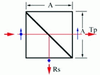
from Foctek Photonics, Inc.
Polarizing CPolarization Cube BeamSplitter tube Beamsplitters split randomly polarized beams into two orthogonal, linearly, polarized components-S-polarized light is reflected at a 90deg.Angle while P-polarized light is transmitted. Each beamsplitter consists of a pair of precision high tolerance... [See More]
- Surface Quality: 60-40 Scratch / Dig
- Side Length: 3.2
- Polarizer Construction: Cement
- Wavelength Range: 488 to 1550

from Tower Optical Corporation
These beamsplitters are based upon using two complementary prisms. The output beam that is parallel to the input beam is p-polarized, while the orthogonal output beam is s-polarized. [See More]
- Surface Quality: 60-40 Scratch / Dig
- Wavelength Range: 226 to 2300
- Side Length: 3.2 to 50.8
- Extinction Ratio: 100
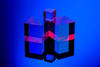
from Daheng New Epoch Technology, Inc.
This is a conventional beam splitter independent of polarization. The incoming light should be one of the following: 45 linearly polarized, circularly polarized or natural light, i.e. the s-polarized and p-polarized components should be equal to within 5% of each other. The outgoing beams are two... [See More]
- Surface Quality: 60-40 Scratch / Dig
- Wavelength Range: 450 to 1600
- Side Length: 12.7 to 25.4
- Beam Deviation: ? to 90

from ECOPTIK (CHANGCHUN) LTD
Polarization Cube Beamsplitter. Polarizing cube beamsplitters split randomly polarized beams into two orthogonal, linearly, polarized components, S-polarized light is reflected at a 90 ° while P-polarized light is transmitted. Each beamsplitter consists of a pair of precision high tolerance... [See More]
- Surface Quality: 40-20 Scratch / Dig; 60-40 Scratch / Dig
- Polarizer Material: BK7; Other Material; ZF Glass
- Transmission: 95 to 96
- Surface Flatness: λ/4

from Artifex Engineering
Economical polarizers, useful when the extinction ratio of a crystal polarizer is not required. A polarizing cube beamsplitter consists of a pair of right angle prisms cemented together. The hypotenuse face of one prism is coated with a special multilayer dielectric coating. When non-polarized light... [See More]
- Surface Quality: 60-40 Scratch / Dig
- Wavelength Range: 405 to 1550
- Polarizer Construction: Cement
- Extinction Ratio: 300

from HG Optronics, Inc.
Beamsplitter Cubes are constructed by cemented two right angle prisms. The hypotenuse of one prism is coated with polarization dielectric coating. 3.1 Compared with beamsplitter plate, beamsplitter cube has the following advantages: Identical path length for both the reflected and the transmitted... [See More]
- Surface Quality: 60-40 Scratch / Dig
- Beam Deviation: 180
- Polarizer Construction: Cement
- Type of Antireflection Coating: Hypotenuse face Broadband Polarization beamsplitter coating All Input and Output face BBAR Coating
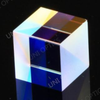
from UNI OPTICS(Fujian) Co., Ltd
Beamsplitter Cubes are constructed by cemented two right angle prisms. The hypotenuse of one prism is coated with polarization dielectric coating. Compared with beamsplitter plate, beamsplitter cube has the following advantages: * Identical path length for both the reflected and the transmitted... [See More]
- Surface Quality: 60-40 Scratch / Dig
- Side Length: 2.1 to 30
- Polarizer Construction: Cement
- Transmission: 90

from Foctek Photonics, Inc.
Polarizing CPolarization Cube BeamSplitter tube Beamsplitters split randomly polarized beams into two orthogonal, linearly, polarized components-S-polarized light is reflected at a 90deg.Angle while P-polarized light is transmitted. Each beamsplitter consists of a pair of precision high tolerance... [See More]
- Surface Quality: 60-40 Scratch / Dig
- Wavelength Range: 532 to 1064
- Side Length: 3.2 to 15
- Extinction Ratio: 1000

from Daheng New Epoch Technology, Inc.
The mixed layer of the broadband non-polarizing prism has a certain absorption of light energy, but it is not sensitive on the polarization state. The same spectral characteristic can be maintained at wide wavelengths, and is suitable for tunable lasers. Mixed splitter film pair is insensitive about... [See More]
- Surface Quality: 60-40 Scratch / Dig
- Wavelength Range: 450 to 1600
- Side Length: 12.7 to 25.4
- Beam Deviation: 90

from HG Optronics, Inc.
Non-Polarizing Cube Beamsplitters also called NPBS Cube is a more sophisticated type consisting of two right- angle prisms cemented together at their hypotenuse faces.The cemented face of one prism is coated. Before cementing, with a metallic or dielectric layer having the desired reflecting... [See More]
- Surface Quality: 60-40 Scratch / Dig
- Beam Deviation: 180
- Polarizer Construction: Cement
- Polarizer Features: Anti-Reflection Coating

from UNI OPTICS(Fujian) Co., Ltd
Beamsplitter Penta Prism by adding a wedge and with partial reflective coating on one of its leaning surfaces, Penta Prism can be used as Beamsplitter. Transmission/reflection (T/R) ratio of 50/50, or others for Beamsplitter Penta Prism is available upon request. [See More]
- Surface Quality: 60-40 Scratch / Dig
- Transmission: 50
- Polarizer Construction: Cement
- Polarizer Features: Anti-Reflection Coating (optional feature)