
Handwheels Information
Last revised: January 10, 2025
Reviewed by: Scott Orlosky, consulting engineer 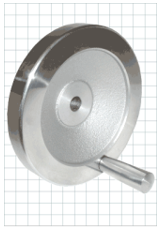
Handwheels are manually-operated devices that revolve around an axis. They are used to adjust machinery and control access to compartments. Typically, the rim serves as a grip; however, many handwheels feature a stationary, revolving, or foldaway handle for ease of use.
Types of Handwheels
Several types of handwheels are available.
Solid wheels do not contain openings between the outside diameter and the inner hub.
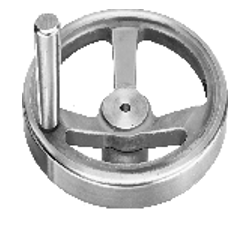
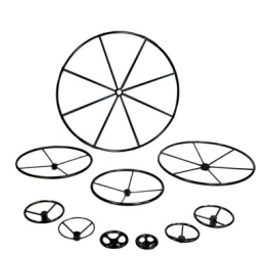
Spoked wheels resemble bicycle wheels and feature multiple supports (spokes) from the inner hub to the outer part of the wheel.
With flat handwheels, the outside diameter of the wheel and outer diameter of the wheel’s hub are on the same plane or a similar plane.
With dished wheels, the outside diameter of the wheel and the outside diameter of the wheel’s hub are on offset planes.
Specifications
Handwheels vary in terms of specifications and features.
Size and Bore Specifications
Size and bore specifications include outside diameter (OD), bore size, and bore type. Typically, both OD and bore size are expressed in inches. For round bores, bore size is the diameter size. For rectangular bores, bore size is the largest measurement across the bore’s flat dimension. Handwheels with hexagonal, square-shaped, or starter bores are also available. In terms of features, some devices include coated finishes, painted spokes, or polished wheels. Others are anodized, knurled or contain a safety clutch or finger grips.
Materials
Handwheels are made from a variety of metals and plastics.
- Aluminum is a lightweight metallic element that offers good electrical and thermal conductivity, high reflectivity, and resistance to oxidation.
- Cast iron is a composite made mainly of iron, but with important trace amounts of carbon and silicon.
- Steel is a commercial iron that differs from cast iron both in terms of its malleability and lower carbon content.
- Stainless steel is chemical and corrosion resistant and can have relatively high pressure ratings.
- Plastic materials for hand wheels include various thermoplastic and thermosetting polymers.
Applications
There are many applications for handwheels. Some devices are used to manually operate valves. Others are used to adjust tables and cutters on machine tools, or to manually drive presses. In the printing industry, handwheels are used to regulate roll tension and feed paper and other materials. Knurled handwheels can be used in place of star-shaped or hand knobs for light adjusting or clamping applications. Specialized handwheels are resistant to solvents, oil, and grease.
Standards
BS EN 754 — System for the direction of rotation of machine tool handwheels and levers relative to movement produced
MIL-H-9859 — Handwheels
GOST 21752-76 — Human being-machine system, control handwheels and steering wheels. General ergonomic requirements
GOST 31.0101.01-89 — General specifications for handwheels, swivel levers, handles, knobs
Handwheel FAQs
What are the key factors to consider when selecting a handwheel for a specific application?
Handle Type
With Handle: Suitable for higher-torque situations where easier operation is needed. Handles can be metal or plastic, revolving or non-revolving, and designed for comfortable gripping with bare hands or gloves. However, handles can be a safety hazard in some environments, so foldaway or "safety" handles might be preferred.
Without Handle: Ideal for applications requiring a motion similar to a steering wheel, providing a smooth operation without the protrusion of a handle.
Material
Consider the material of the handwheel, such as metals or plastic with glass- or nylon-fiber reinforcement, which can improve strength and durability.
Grip Style
Finger Grip Handwheels: These have grooved edges for extra control and grip. Available with or without a handle.
Hub Style
The hub style affects how the handwheel is mounted and balanced. Options include square, hex, half-circle, and screw set hub handwheels. The hub must be compatible with the machinery and allow for easy removal and re-installation during servicing.
Safety Considerations
Ergonomic and safety considerations, such as the potential for handles to be safety hazards, should be taken into account. Foldaway handles can mitigate some safety risks.
What are the safety considerations when using handwheels in industrial environments?
Handle Safety
Handles can be a safety hazard due to their protrusion. In environments where this is a concern, foldaway or "safety" handles that fold into the handwheel body after use can be a safer option.
Ergonomics
Ergonomic design is important to prevent strain or injury. Handwheels should be designed for comfortable gripping, whether with bare hands or gloves, to reduce the risk of repetitive strain injuries.
Grip and Control
Finger grip handwheels, which have grooved edges, can provide extra control and grip, reducing the likelihood of slipping and potential accidents.
Material and Durability
The material of the handwheel, such as metals or reinforced plastic, should be chosen for durability and strength to withstand industrial conditions and prevent breakage that could lead to accidents.
Hub Style and Mounting
Proper hub style and mounting are essential for balance and stability. The hub must be compatible with the machinery to ensure secure attachment and easy removal during servicing, which can prevent operational hazards.
How is the safety of handwheels impacted by their design?
Ergonomic designs enhance user comfort and reduce the risk of injury. Their handles are designed to be comfortable for gripping, whether with bare hands or gloves. This reduces the stress and potential for repetitive strain injuries.
Foldaway or "safety" handles work by folding into the handwheel body after use, preventing accidental contact or injury from protruding handles. Sometimes they are spring-loaded to close when not in use.
Finger grip handwheels, which have grooved edges which provide extra control and grip. These designs reduce the likelihood of slipping, thereby minimizing the risk of accidents.
The use of durable materials, such as metals or reinforced plastic, ensures that handwheels can withstand industrial conditions without breaking, which could otherwise lead to accidents.
Ergonomic designs consider the overall ease of use and comfort, which can prevent operator fatigue and enhance safety by allowing for more precise and controlled operation.
What are the common materials used in handwheel manufacturing?
Metals are frequently used in handwheel manufacturing due to their strength and durability. They are suitable for applications requiring robust performance and can withstand harsh industrial environments.
Plastic handwheels often include glass- or nylon-fiber reinforcement. This reinforcement enhances the strength and durability of the handwheel.
These materials are chosen based on the specific requirements of the application, such as the need for strength, durability, and resistance to environmental factors.
What are the safety features of foldaway handles?
Foldaway handles are designed to fold into the handwheel body after use. This retractable feature helps prevent accidental contact or injury from protruding handles, which can be a safety hazard in certain environments.
The ergonomic design of foldaway handles ensures comfortable gripping, whether with bare hands or gloves. This reduces the risk of repetitive strain injuries and enhances control during operation.
How do hub styles impact the functionality of handwheels?
Hub styles significantly impact the functionality of handwheels by influencing how they are mounted, balanced, and integrated with machinery.
Handwheels typically turn in both directions, so a well-balanced handwheel mounting can ensure stability and smooth operation. This maintains the handwheel's functionality and prevents wobbling during use.
In many applications, handwheels need to be removed and re-installed during machine servicing. Different hub styles, offer varying levels of ease for these processes. Choosing the appropriate hub style can facilitate maintenance and reduce downtime.
The hub style must be compatible with the machinery it is used with. This compatibility ensures that the handwheel can be securely attached and function effectively without causing damage to the machinery or the handwheel itself.
Common hub styles include square, hex, half-circle, and screw set hub handwheels. Each style offers unique benefits and is suited for different applications, depending on the specific requirements of the machinery and the operational environment.
Handwheel Media Gallery
References
Grainger Supply—Handwheels Quick Guide
Image credits:
Carr Lane Manufacturing Co. | Jergens, Inc. | Rotork plc