The Definitive Guide to the ARM Cortex-M3

Chapter 11: Exceptions Programming

Using Interrupts

Interrupts are used in almost all embedded applications. In the Cortex-M3 processor, the interrupt controller NVIC handles a number of processing tasks for you, including priority checking and stacking/unstacking of registers. However, a number of tasks have to be prepared when an interrupt is used:

  • Stack setup

  • Vector table setup

  • Interrupt priority setup

  • Enable the interrupt

Stack Setup

For simple application development, you can use the MSP for the whole program. That way you need to reserve memory that's just large enough and set the MSP to the top of the stack. When determining the stack size required, besides checking the stack level that could be used by the software, you also need to check how many levels of nested interrupts can occur.

For each level of nested interrupts, you need at least eight words of stack. The processing inside interrupt handlers might need extra stack space as well.

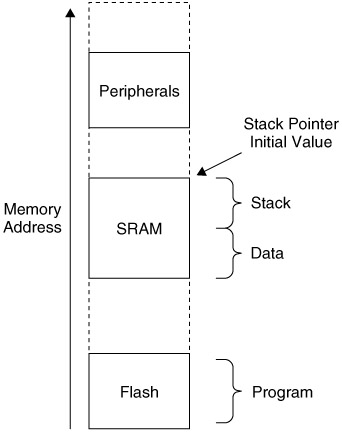
Since the stack operation in the Cortex-M3 is full descending, it is common to put the stack initial value at the end of the static memory so that the free space in the SRAM is not fragmented.


Figure 11.1: A Simple Memory Usage Example

For applications that use separate stacks for user code and kernel code, the main stack should have enough memory for the nested interrupt handlers as well as the stack memory used by the kernel code. The process stack should have enough memory for the user application code plus one level of stacking space (eight words).

UNLIMITED FREE
ACCESS
TO THE WORLD'S BEST IDEAS

SUBMIT
Already a GlobalSpec user? Log in.

This is embarrasing...

An error occurred while processing the form. Please try again in a few minutes.

Customize Your GlobalSpec Experience

Category: Embedded Programming Software
Finish!
Privacy Policy

This is embarrasing...

An error occurred while processing the form. Please try again in a few minutes.