The Definitive Guide to the ARM Cortex-M3

Chapter 16: Debugging Components

Introduction

The Cortex-M3 processor comes with a number of debugging components used to provide debugging features such as breakpoint, watchpoint, Flash patch, and trace. If you are an application developer, there might be a chance that you'll never need to know the details about these debugging components, because they are normally used only by debugger tools. This chapter will introduce you to the basics of each debug component. If you want to know details about things such as the actual programmer's model, refer to the Cortex-M3 Technical Reference Manual (Ref 1).

All the debug trace components, as well as the FPB, can be programmed via the Cortex-M3 Private Peripheral Bus (PPB). In most cases, the components will only be programmed by the debugging host. It is not recommended for applications to try accessing the debug components (except stimulus port registers in the ITM), because this could interfere with the debugger's operation.

The Trace System in the Cortex-M3

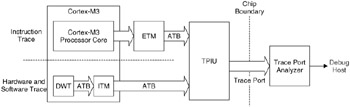
The Cortex-M3 trace system is based on the CoreSight architecture. Trace results are generated in the form of packets, which can be of various lengths (in terms of number of bytes). The trace components transfer the packets using Advanced Trace Bus (ATB) to the Trace Port Interface Unit (TPIU), which formats the packets into Trace Interface Protocol. The data are then captured by an external trace capture device such as a Trace Port Analyzer (TPA).


Figure 16.1: The Cortex-M3 Trace System

There are up to three trace sources in a standard Cortex-M3...

UNLIMITED FREE
ACCESS
TO THE WORLD'S BEST IDEAS

SUBMIT
Already a GlobalSpec user? Log in.

This is embarrasing...

An error occurred while processing the form. Please try again in a few minutes.

Customize Your GlobalSpec Experience

Category: Network Test Equipment
Finish!
Privacy Policy

This is embarrasing...

An error occurred while processing the form. Please try again in a few minutes.