Digital Imaging
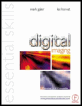
Provides a comprehensive practical guide to the entire digital chain, from capture -- with coverage of digital cameras, to output -- with extensive information on image adjustments and colour management.
 TABLE OF CONTENTS
 To develop an awareness and understanding of colour management issues.
To develop an understanding of how colour is formed and defined in the digital medium.
To understand how to implement a colour managed workflow.
Research the different forms of how colour is defined, both with light and with inks. Record your observations and findings,
Analyse and evaluate critically your findings and exchange with others.
Create a personal target file for output and testing to facilitate further colour control.
As noted in 'Digital Basics', the three fundamental aspects of colour are hue, saturation and brightness. However as we are only too well aware, perceptions of colour vary from person to person and are also affected by the history of colour experience of the individual. To add further complexity to an already subjective issue the different ways that we reproduce colour, through the mechanical and electronic devices at our disposal, have significant limitations that may ultimately alter the actual colour produced.
This is a question that often leads to confusion and mis-understanding, so let's begin with a definition of three important terms:
Colour management - is the adoption of a system whereby all 'devices' within a chain used to create a colour image are referenced and linked together to produce predictable, consistent colour.
A Colour Management System (CMS) - is the calibration and profiling of both input and output devices, so that the colour image printed is an accurate...