Radar and Laser Cross Section Engineering, Second Edition
4.2: Relationship Between Time and Frequency

4.2 Relationship Between Time and Frequency

4.2.1 Impulse and Frequency Responses of Linear Systems

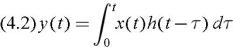
Consider a two-port model of a linear time-invariant system shown in Fig. 4.2. A signal x(t) is applied to the input, and the response y(t) is observed at the output. The response is obtained as the convolution of the input x(t) and the system impulse response h(t)9:


Fig. 4.2: Two-port model of a linear system.

If the signal x(t) is zero for t < 0 and the system is causal, that is, the impulse response h(t) is zero for t < 0, the convolution integral can be written as


The system impulse response is the system s response to a Dirac delta function ?(t), which is nonzero only at t = 0. A causal system does not generate a response that precedes the excitation and, thus, the response of a causal system must be zero for t < 0. Using the property that the Fourier transform of a convolution is the product of Fourier transforms,9 gives the input-output relationship in the frequency domain:


where the operator denotes a Fourier transform. Equation (4.3) can be written as


where the upper-case letters denote the Fourier transforms of the lower-case time functions (e.g., X( ?) = { x(t)}). The function H( ?) is the system s frequency response.

The linear system concept just discussed can be extended to linear time-invariant systems with...

UNLIMITED FREE
ACCESS
TO THE WORLD'S BEST IDEAS

SUBMIT
Already a GlobalSpec user? Log in.

This is embarrasing...

An error occurred while processing the form. Please try again in a few minutes.

Customize Your GlobalSpec Experience

Category: IC Electronic Filters
Finish!
Privacy Policy

This is embarrasing...

An error occurred while processing the form. Please try again in a few minutes.