Radar and Laser Cross Section Engineering, Second Edition
4.1 Calculate the effective duration and effective bandwidth ( T eff and B eff) of a Gaussian pulse with f(t) given by Eq. (4.39).
4.2 The physical optics approximation can be applied to the time domain as well as the frequency domain.3 The radiation integral with the frequency dependence explicitly written is
for r/2 ? 1 /2 ?.
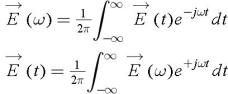
Use the Fourier transform pair
to derive the time-domain form of the radiation integral
Use the fact that, for time-harmonic fields,
and
with k = ?/c to obtain at
Note that
(t) depends on the derivative of the current and that the
current component does not contribute to the radiated field, just as in the harmonic case.
4.3 In this problem, we use Eq. (P4.1), derived in Problem 4.2, to determine the approximate time-domain scattering from a flat conducting plate. Assume the following:
Plate of dimensions L x L y lies in the x y plane;
Wave incident in the y z plane; and
Observation point in the far field (i.e., parallel rays from the plate surface to the observation point).
The incident field is given by
where T = 1 /f is the carrier period and U(t) the unit step function.
What is the current induced on the plate by the incident wave according to the physical optics approximation?
Show...