Radar and Laser Cross Section Engineering, Second Edition
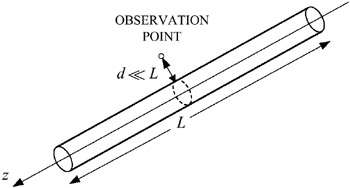
The incident and scattered electromagnetic fields and the media parameters in two-dimensional problems are independent of one of the three spatial coordinates. There are cases where a two-dimensional problem may be solved in place of a related three-dimensional problem. For example, say that we are interested in finding the scattered field from a very long circular cylinder at an observation point that is close to the cylinder, as depicted in Fig. 4.28. In this case, the scattered field is determined primarily by the current on the cylinder surface in the vicinity of the observation point. Furthermore, if d ? L , then the effects of the cylinder edges can be neglected, and the current distribution on the finite cylinder approaches that of an infinitely long cylinder. The three-dimensional RCS can be estimated from the two-dimensional RCS (often called the echo width) by
Working in the Cartesian system, we will denote z as the independent axis. The field invariance with z can be expressed mathematically as
The electric and magnetic fields will thus be functions of the spatial coordinates x and y and of time t. All media will be assumed stationary.
An arbitrary two-dimensional electromagnetic field can be expressed as a linear combination (superposition) of TE z and TM z components. The TE z