Radar and Laser Cross Section Engineering, Second Edition
Chapter 9: Laser Cross Section

9.1 Introduction

Laser radars are commonly referred to as ladar for laser radar or as lidar for light detection and ranging. They operate on the same principles as microwave radar.1 ,2 Ranging is accomplished by measuring the time delay to and from the target. Angular information is obtained from the antenna beam-pointing direction or from the target s Doppler shift. Laser radars are capable of extremely accurate angular measurement because of the small beam diameters of lasers (on transmit) and narrow fields of view (on receive). On the negative side, the detection and tracking ranges are much shorter than microwave radar because of lower transmitter power and higher atmospheric attenuation.

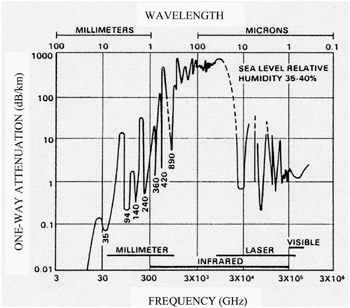
Atmospheric transmittance as a function of wavelength is shown in Fig. 9.1. Ladars usually operate in the 10.6- m [*] wavelength region in the far infrared and the 1.06- m wavelength region in the visible.3 The former use CO 2 lasers and the latter neodymium YAG (yttrium aluminum garnet) crystal lasers with typical efficiencies of 10% and 3%, respectively.4 6


Fig. 9.1: Atmospheric transmittance (from Ref. 4, courtesy Artech House, www. artechhouse.com).

[*]The standard length unit is micrometers or microns, which is 10 ?6 m. It is sometimes denoted by , but m will be used here to avoid confusion with permeability.

9.2 Scattering and Propagation of Light

The scattering and propagation of light obey the same set of laws as radar waves, that is, those...

UNLIMITED FREE
ACCESS
TO THE WORLD'S BEST IDEAS

SUBMIT
Already a GlobalSpec user? Log in.

This is embarrasing...

An error occurred while processing the form. Please try again in a few minutes.

Customize Your GlobalSpec Experience

Category: Laser Cutting and Welding Machines
Finish!
Privacy Policy

This is embarrasing...

An error occurred while processing the form. Please try again in a few minutes.