Radar and Laser Cross Section Engineering, Second Edition

4.4: Finite Difference Time-Domain Equations in One Dimension

4.4 Finite Difference Time-Domain Equations in One Dimension

4.4.1 Derivation of the Magnetic Field Update Equation

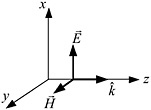
The incident and scattered electromagnetic fields and the media parameters in one-dimensional problems vary with only one spatial coordinate. We will choose this coordinate to be the z axis. The fields will also be functions of time t. The media will be assumed stationary (i.e., media parameters such as and ? are independent of t). One-dimensional electromagnetic fields must be TEM, that is, the field vectors and are orthogonal and lie in a plane transverse to the direction of propagation. Because we have denoted the direction of propagation as z, the fields are TEM z. The triplet of vectors ( , , ) are mutually orthogonal and form a right-handed system, as shown in Fig. 4.10. The coordinate axes are selected so that the electric field vector is x-directed and the magnetic field vector is y-directed


Fig. 4.10: TEM z field components in a one-dimensional medium.

The electric and magnetic fields satisfy Maxwell s equations, which express the electric and magnetic field coupling. They can be written in integral or differential form as described in Appendix A. We will use the integral forms because they are applicable to finite domains (lines, surfaces, or volumes), whereas the differential forms are applicable to infinitesimaly small domains (points). The integral forms of Maxwell s first two equations for a TEM z field are:

UNLIMITED FREE
ACCESS
TO THE WORLD'S BEST IDEAS

SUBMIT
Already a GlobalSpec user? Log in.

This is embarrasing...

An error occurred while processing the form. Please try again in a few minutes.

Customize Your GlobalSpec Experience

Category: Finite-difference time-domain (FDTD) Software
Finish!
Privacy Policy

This is embarrasing...

An error occurred while processing the form. Please try again in a few minutes.